PRACTICAL SEO RESEARCH
SEnuke TNG: A Pre-Purchase Workflow, Permissions and Output Audit
SEnuke TNG is a product name that appears in discussions of SEO automation.
Published 31 October 2026 · Updated 31 October 2026 · BlackHatSEOCourse.in Editorial · 3,096 words · 15 min read
Detailed SEO guide and resources
On this page
The practical starting pointConfirm the exact product and versionDefine the permitted automation taskReview credentials and permissionsInspect each input before executionExamine outputs at the record levelCheck controls for stopping and recoveryCompare automation with a simpler workflowKeep a dated purchase decisionWorked scenario: applying the reviewBuild the working evidence filePlan a bounded pilot before committingMeasure effort, outcomes and uncertaintyTurn the review into a maintainable decisionYour printable review checklistFrequently asked questionsContinue with related resourcesFurther reference materialGet the complete printable guideThe practical starting point
SEnuke TNG is a product name that appears in discussions of SEO automation. Before evaluating any version or subscription, verify the current official product information and identify the task you actually need to perform. This guide does not assume that a historical feature list remains accurate. Instead, it provides a structured way to inspect a demonstration, permissions, output quality and total operating effort. That approach is useful for learners researching the name and teams deciding whether an automation product fits an authorized workflow. A tool should be judged by what it demonstrably does under your conditions, rather than by the breadth of its marketing language.
Confirm the exact product and version
Record the official product identity, version, seller and date of the material you are reviewing. Search results can contain old tutorials, affiliate pages and unrelated downloads. Do not combine their claims into a fictional current feature list. If a capability matters to the purchase, ask the vendor to demonstrate it in the offered version. Keep the evidence with the procurement record.
Related resource: Senuke Tng 2026 Search Guide.
Evidence to retain
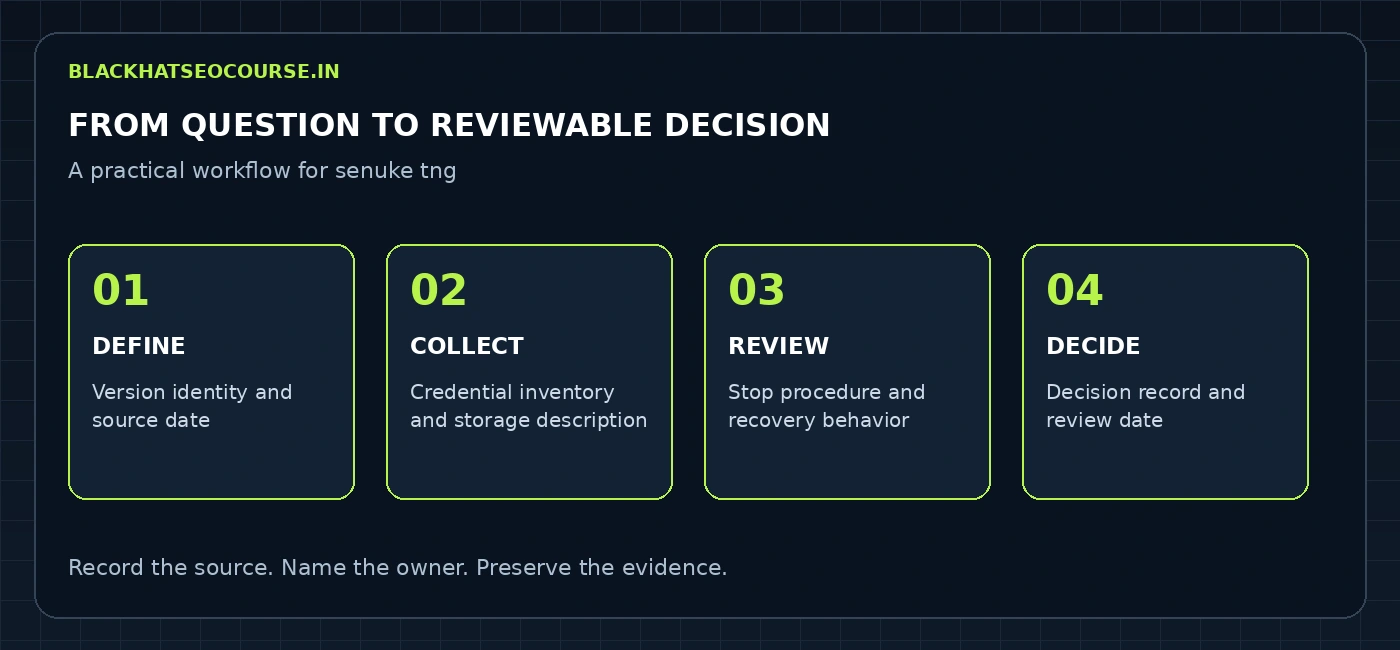
Version identity and source date. Record who supplied the information and what it directly demonstrates. Keep your interpretation separate from the original material. If the source is incomplete, mark the item for follow-up rather than silently treating the missing detail as a favorable answer.
Match the demo version with the plan and download being offered.
Define the permitted automation task
Write down the repetitive work you intend to reduce and where it takes place. Distinguish internal reporting from publishing or interacting with third-party platforms. Confirm that you have authorization and that the destination permits the activity. A task that is technically possible may still be unsuitable for your business. Start with a small bounded workflow whose inputs and outputs are easy to inspect.
Related resource: Senuke Tng Guide.
Evidence to retain
Task scope and destination requirements. Review a representative example before expanding the work. The example should match the actual task and preserve enough context for a second person to inspect it. A summary is useful only when the underlying observation remains available and understandable.
Describe one permitted use without relying on a broad automation promise.
Review credentials and permissions
Identify every account, token and local permission the workflow requests. Ask where data is stored and how access is revoked. Use a controlled test environment and avoid providing unrelated business credentials. If installation requires broad system access, evaluate that requirement through your normal software-review process. A clear explanation of permissions should be part of the demonstration rather than an afterthought.
Related resource: Senuke Tng.
Evidence to retain
Credential inventory and storage description. Name the person responsible for checking this item and record the review date. If the answer depends on a version, location or commercial arrangement, retain that condition. A finding that is true in one context may require a different decision elsewhere.
Map each requested permission to a necessary workflow action.
Inspect each input before execution
Automation multiplies the quality of its inputs. A poorly scoped URL list, inaccurate text or mismatched account configuration can produce many errors quickly. Validate a tiny sample manually and record the accepted format. Make sure the content and destinations are appropriate to the task. Keep an untouched copy so a failed test can be diagnosed without guessing what the tool received.
Related resource: Senuke 2026 Search Guide.
Evidence to retain
Validated input sample and format. Keep an unresolved-questions field beside the decision. This prevents a provisional interpretation from becoming an assumed fact during handover. Identify the smallest additional observation that would resolve the uncertainty before authorizing a larger commitment.
Run a dry review of the first five records before starting a job.
Examine outputs at the record level
A completion counter does not establish a useful result. Open representative outputs and confirm that they match the authorized task. Record failures, unexpected changes and any cleanup required. If the process publishes material, review the visible result and relevant attribution. If it generates reports, verify values against the source. Do not scale based solely on a dashboard that labels a job successful.
Related resource: Black Hat Seo And Automation Tools.
Evidence to retain
Output sample and exception list. Check the proposed next action against the original reader or business need. An easy task is not necessarily a useful one. Explain the expected benefit in plain language so a reviewer can judge its relevance without relying on a tool score.
Verify at least one successful record and one reported failure independently.
Check controls for stopping and recovery
Determine whether jobs can be paused, cancelled or safely retried. Ask what happens if a connection fails halfway through. A useful automation workflow should identify completed records and avoid duplicating work during recovery. Preserve a log of inputs, timestamps and outcomes. If cleanup requires manual intervention, include that effort in the decision. Reversibility matters more as the affected record count grows.
Related resource: Seo Automation Tools.
Evidence to retain
Stop procedure and recovery behavior. Preserve one example of a limitation as well as a successful observation. This makes the review more balanced and helps future users recognize where the process stops being reliable. Explain how that limitation affects the decision rather than hiding it in a general footnote.
Interrupt a harmless test and inspect how the tool reports partial completion.
Compare automation with a simpler workflow
The alternative may be a spreadsheet, an export or a small amount of manual work. Estimate setup, monitoring, correction and reporting time alongside subscription costs. A product that saves execution time can still require more supervision than the original process. Compare the same finished output rather than the apparent speed of a demonstration. Use the simplest workflow that meets the actual requirement.
Related resource: Ahrefs Webmaster Tools 2026 Search Guide.
Evidence to retain
Manual comparison and total effort. Agree on the completion check before the work starts. The check should establish the intended behavior using evidence available to the reviewer. If the result is different from the plan, record the difference and decide whether the action needs revision.
Time a small manual sample before estimating potential savings.
Keep a dated purchase decision
Summarize verified capabilities, unresolved questions, permissions and observed limitations. If the vendor cannot demonstrate an essential requirement, defer the purchase or choose another process. Preserve the decision date because product behavior and terms can change. A learner can still use the evaluation as an exercise in software judgment without needing to subscribe. The record should explain the decision to someone who did not attend the demo.
Related resource: Api Seo Automation.
Evidence to retain
Decision record and review date. Make the handover useful to the next person. Include the source, reasoning, decision and any maintenance trigger. A concise record with clear ownership is easier to continue than an unexplained collection of screenshots, links or exported rows.
List which claims were verified and which remain marketing assertions.
Worked scenario: applying the review
Illustrative example. This is a planning exercise, not a reported client result.
Suppose a team encounters a tutorial referring to SEnuke TNG while researching automation. The first step is to identify whether the material describes the version currently offered by an official seller. The team does not assume that old screenshots establish present capabilities. It writes down one permitted task, the expected output and the credentials that a demonstration would require. Unrelated business accounts remain outside the evaluation.
A harmless input sample is reviewed manually before any test. The evaluator records the setup time, watches the job, opens individual outputs and examines an intentionally interrupted run. The important questions are whether partial completion is visible, whether retries duplicate work and how the task can be stopped. A completion counter receives little weight if its records cannot be verified independently.
The final comparison includes a simpler manual workflow. If installation, supervision and correction exceed the time saved, the team can reasonably decline the purchase even when the software performs the demonstrated action. The evaluation file lists exact verified capabilities and unanswered questions, with a date and version. That record is useful learning in itself: it separates software procurement from enthusiasm generated by a historical tutorial or an impressive-looking automated sequence.
Build the working evidence file
Use this exercise as a practical learning assignment for an SEO team researching an automation product before purchase. Gather official version information, a permitted task, a small input sample and output logs and identify which parts you can inspect directly. Write down what you expect to learn before viewing the result. The assignment ends with a version-specific automation evaluation with permissions and recovery notes, rather than a collection of screenshots with no explanation. A learner should be able to repeat the reasoning later, understand where an assumption entered the process and recognize when different circumstances require a different decision.
Use a simple record with an item identifier, the original source, the observation, the interpretation, the proposed action and the reviewer. For example, the first record in this guide concerns version identity and source date. Preserve the original evidence alongside the summary, because summaries can accidentally omit an important condition. Record missing information explicitly. An empty cell should mean the item has not yet been reviewed, while a completed review with insufficient evidence should have a written reason. Those are different states and should not be confused in a progress report.
Keep the file proportionate to the assignment. A small review may need only a few carefully documented rows. Adding hundreds of incomplete entries can make the work harder to prioritize. Ask the workflow owner and the software administrator to agree on the first decision the file must support, then collect only the information needed for that decision. Protect confidential material and use anonymized examples when the reasoning does not depend on identity. The aim is a reusable record that supports scrutiny, rather than a large archive nobody can interpret.
Plan a bounded pilot before committing
The suggested pilot is to test a handful of harmless authorized records in a controlled environment. State the starting condition and the expected output before beginning. Keep its scope small enough that you can inspect every important result. Do not use a favorable first observation as permission to expand into unrelated work. A pilot answers a defined question about usefulness, delivery or interpretation; it is not a miniature promise that the same outcome will hold at any scale. Record what the exercise deliberately leaves untested.
Set practical acceptance criteria. The output should address the reader or business task, expose supporting evidence and explain unresolved limitations. Assign the review to the workflow owner and the software administrator. Agree how defects or unanswered questions will be handled and who can authorize a revised scope. A review date is a checkpoint, not an instruction to invent certainty when the evidence is incomplete. If an essential input is unavailable, the correct result may be to pause the decision and obtain it, rather than proceed on a convenient assumption.
Use a stop condition as well as a success condition. In this case, a reason to stop or investigate is that the product cannot demonstrate a necessary control or explain how credentials are handled. Document that condition before the work begins so sunk effort does not become the reason to continue. Preserve useful partial findings, explain what would need to change and identify a smaller alternative if appropriate. This makes a declined opportunity or an inconclusive pilot a reviewable outcome. The process has value when it prevents an unjustified commitment as well as when it supports a sensible next step.
Measure effort, outcomes and uncertainty
The primary operating measures are verified correct outputs and net time saved after supervision and cleanup. Define the units, source and review period for each before comparing results. Keep completed work separate from observed performance. A deliverable can be verified directly, while an outcome may depend on demand, timing, other releases or actions outside the team's control. This distinction makes reporting more honest and useful: the reader can see both whether the team fulfilled the brief and what the available observations suggest about its wider value.
Consider this illustrative planning example: saving forty minutes of execution is not a net saving when setup and corrections take an additional hour. These figures describe a method of comparison, not an audited result or forecast. Replace them with actual records before using them to justify expenditure. Include staff time, review, cleanup and maintenance in the comparison. A low purchase price can conceal a substantial operating burden, while a more focused option may deliver a useful result with less recurring work. Write down the assumptions that would change the decision so the calculation can be revisited without reconstructing the whole discussion.
Review the quality of the evidence rather than only the direction of a chart. Check whether definitions stayed consistent, whether the sample represents the task and whether another event offers a plausible explanation. For senuke tng, the evaluation should remain tied to the specific observations documented in this guide. If counts are small or access is limited, narrow the conclusion accordingly. Record what additional evidence would strengthen or overturn it. A careful uncertainty note tells the next reviewer where to focus, instead of using vague caution to avoid making any practical recommendation.
Turn the review into a maintainable decision
The final record should state the chosen action, why it fits the evidence and what remains unresolved. Deliver a version-specific automation evaluation with permissions and recovery notes with its original inputs, dated observations and next review trigger. Identify the person responsible for maintaining the record. A decision that depends on a product version, publishing arrangement, institutional fact or website configuration can become stale when that dependency changes. The handover should make those dependencies visible, so a later reviewer knows what needs rechecking rather than assuming the original conclusion remains permanently valid.
Translate the review into a small set of owned tasks. Each task needs a specific output, a responsible person, necessary inputs and an acceptance check. Use the actions in the eight sections above as starting points rather than generic instructions to improve SEO. For example, revisit the evidence for decision record and review date before expanding the work. If two tasks depend on the same unresolved question, resolve it once and share the result. This reduces repeated research and avoids different team members making contradictory assumptions about the same issue.
After implementation or procurement, verify the intended behavior and capture any differences from the plan. Review verified correct outputs and net time saved after supervision and cleanup at the agreed checkpoint and explain what the comparison can support. Keep useful unsuccessful findings, because they show which assumptions were tested and which approach should not be repeated without new evidence. A future update should improve the substance of the record, not merely refresh its visible date. The durable outcome is a clear, accountable process that another person can understand and continue when the original reviewer is no longer available.
Your printable review checklist
| Step | Evidence | Next action |
|---|---|---|
| 01 | Version identity and source date | Match the demo version with the plan and download being offered. |
| 02 | Task scope and destination requirements | Describe one permitted use without relying on a broad automation promise. |
| 03 | Credential inventory and storage description | Map each requested permission to a necessary workflow action. |
| 04 | Validated input sample and format | Run a dry review of the first five records before starting a job. |
| 05 | Output sample and exception list | Verify at least one successful record and one reported failure independently. |
| 06 | Stop procedure and recovery behavior | Interrupt a harmless test and inspect how the tool reports partial completion. |
| 07 | Manual comparison and total effort | Time a small manual sample before estimating potential savings. |
| 08 | Decision record and review date | List which claims were verified and which remain marketing assertions. |
Keep the source and review date beside each completed row. Use the full PDF for an offline copy of this guide.
Frequently asked questions
What is SEnuke TNG?
It is a product name associated with SEO automation discussions. Verify its current official identity, offered version and capabilities before evaluating it. Historical tutorials and third-party descriptions should not be combined into an assumed current specification.
Does this guide verify current features?
No. It provides an evaluation method rather than an unverified feature catalogue. Any capability that matters to a purchase should be confirmed in current official information and, where practical, demonstrated in the exact offered version.
What should I test before subscribing?
Choose one permitted task with a tiny validated input sample. Inspect outputs, exceptions, permissions and recovery behavior. Compare the complete effort with a simpler method. The test should answer a real operating question rather than merely reproduce a promotional demonstration.
Can automation be judged by its completion count?
No. A count does not show whether records are correct, appropriate or useful. Inspect representative outputs and failures independently. Include cleanup and correction time when evaluating performance, especially before increasing the scale of a workflow.
Should I provide production credentials for a demo?
Use a controlled test setup and only the access necessary for the task. Understand storage and revocation. Follow your organization's software-review practices before providing business credentials or granting broad local permissions.
Why is a stop procedure important?
A workflow can fail or behave unexpectedly after partial completion. You need to know which records changed, whether retries duplicate work and how to recover. Test these controls on harmless data before relying on the tool for a larger job.
What costs should the comparison include?
Include subscription, setup, monitoring, correction, reporting and any required external services. Compare finished useful outputs with the manual alternative. Execution speed alone can exaggerate savings when the workflow needs substantial supervision.
Can an old tutorial guide a current purchase?
It can provide historical context, but version differences may invalidate its instructions or claims. Record its date and confirm essential points against current official material. Avoid using outdated screenshots as proof that a present plan includes a feature.
When should I decline the purchase?
Decline or defer when essential capabilities cannot be demonstrated, permissions are unclear or recovery controls are inadequate for the task. Document the missing requirement. A careful evaluation can justify using a simpler process instead.
How should the final evaluation be saved?
Keep the exact version, date, task, input sample, observed outputs, permissions, costs and unresolved questions. Another reviewer should be able to understand why the decision was made and which parts may need rechecking later.
Further reference material
Use current official documentation when verifying search terminology, technical requirements or platform policies.
Get the complete printable guide
Save the full article, worked scenario, checklist and all 10 FAQ answers for offline review.