Ahrefs Academy: Turn SEO Lessons into a Practical Learning Plan
Use Ahrefs Academy as a starting point for a structured SEO study plan, with practical exercises, evidence logs and independent review.
Start with the official learning source
Ahrefs Academy is Ahrefs' own educational resource, with video tutorials and learning material about its tools and digital marketing. Use the official Academy page to check the current course catalog and access details. This article is an independent learning companion from BlackHatSEOCourse.in, not an Ahrefs course or certification offer. Its purpose is to help learners turn a lesson into a useful practice task rather than simply collect completed videos.
- Define the reader task before choosing a tactic.
- Keep observations separate from assumptions.
- Preserve relevant existing resources.
- Record changes and review their outcomes.
Table of contents
- Start with the official learning source
- Query Performance Snapshot
- Start with the official learning source
- Turn a lesson into one reproducible exercise
- Build a learning sequence around decisions
- Review your work against explicit criteria
- Create a portfolio of defensible examples
- Measurement and review plan
- Related resources from the report
- Visual learning and implementation workbook
- Frequently asked questions
- Image credit and reuse
- Download the companion PDF
- Official sources and further checks
- Choose your next action
- BlackHatSEOCourse.in
- Five new learning guides
Query Performance Snapshot
| Query | Clicks | Impressions | CTR | Avg Position |
|---|---|---|---|---|
| ahrefs academy | 0 | 785 | 0.00% | 27.03 |
These historical measurements come from the supplied Queries sheet. They describe this property and report scope, not total market demand or a current live ranking. The Queries and Pages tabs are not joined query-to-page data.
Start with the official learning source
Ahrefs Academy is Ahrefs' own educational resource, with video tutorials and learning material about its tools and digital marketing. Use the official Academy page to check the current course catalog and access details. This article is an independent learning companion from BlackHatSEOCourse.in, not an Ahrefs course or certification offer. Its purpose is to help learners turn a lesson into a useful practice task rather than simply collect completed videos.
Write down the skill you want to improve before choosing material. A beginner might need to distinguish crawling, indexing and ranking; an experienced editor might need a better way to assess search intent. Define a small outcome such as a reviewed keyword map or a documented technical check. Keep course completion separate from demonstrated ability to apply the concept.
Turn a lesson into one reproducible exercise
After a lesson, choose one permitted website or sample page and apply a single concept. Record the question, the input data, the steps you followed and the limitation of the result. For keyword research, distinguish a third-party estimate from the impressions recorded for a specific Search Console property. For a site audit, review a sample of findings manually rather than accepting every automated recommendation.
Keep exercises narrow enough that another learner can reproduce the reasoning. A short annotated page comparison can teach more than a large spreadsheet with no explanation. Use only accounts and properties you are authorized to inspect. When a tool feature requires access you do not have, document that dependency instead of pretending an exported sample proves the same result.
Continue with BlackHatSEOCourse.in overview as a complementary reference. Sector and technique pages have their own scope; a report entry is not evidence that a tactic works or that one industry example applies to another.
Build a learning sequence around decisions
Study concepts in an order that connects discovery, page purpose, technical eligibility and measurement. Begin by understanding the reader task, then examine whether the intended page can be discovered and understood. Add content and internal-link decisions after those foundations. Treat tool-specific workflows as a way to answer a question, not as a substitute for knowing why the question matters.
Use a simple backlog with the skill, exercise, evidence and review status. Avoid trying many advanced tactics before you can explain the basic signals. If two tools disagree, compare their scope and collection method. A useful learning outcome is the ability to explain what a report measures and what it cannot establish.
Review your work against explicit criteria
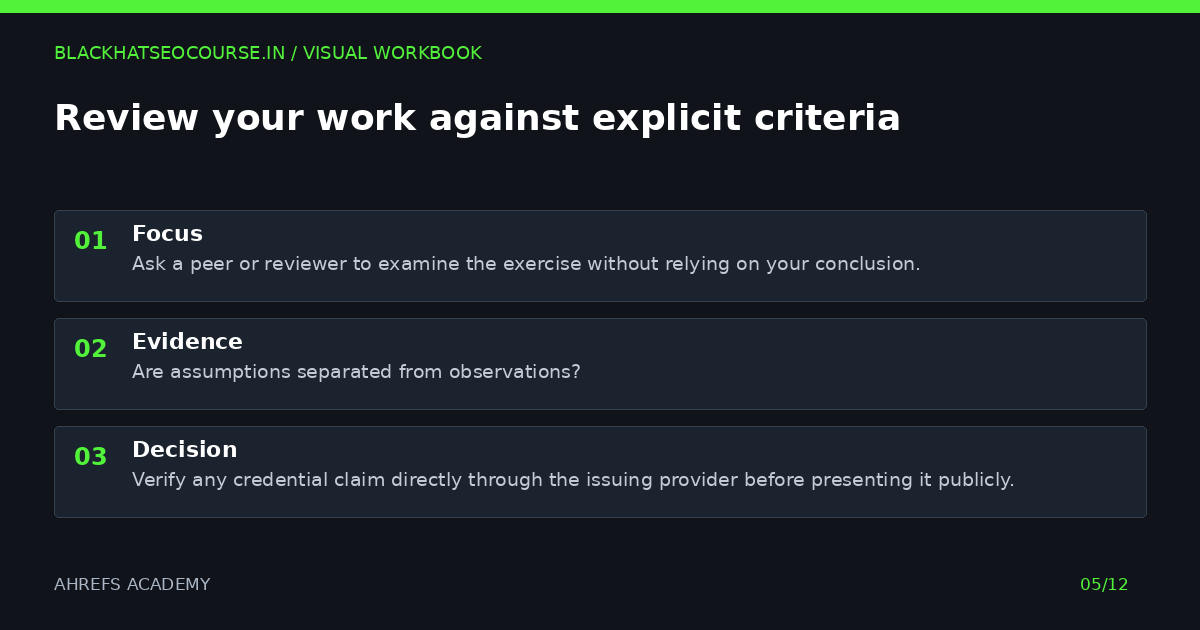
Ask a peer or reviewer to examine the exercise without relying on your conclusion. Can they identify the affected URL, understand the evidence and repeat the check? Are assumptions separated from observations? For a content brief, can the reviewer state the intended audience and the decision the page should help them make? A correct tool screenshot alone does not demonstrate that the recommended change is appropriate.
Keep an error log as well as successful examples. If you misread a canonical signal or confuse a query estimate with actual website exposure, record the correction and the reason. This creates a more valuable reference than a list of certificates or completion badges. Verify any credential claim directly through the issuing provider before presenting it publicly.
Continue with Black hat seo course free as a complementary reference. Sector and technique pages have their own scope; a report entry is not evidence that a tactic works or that one industry example applies to another.
Create a portfolio of defensible examples
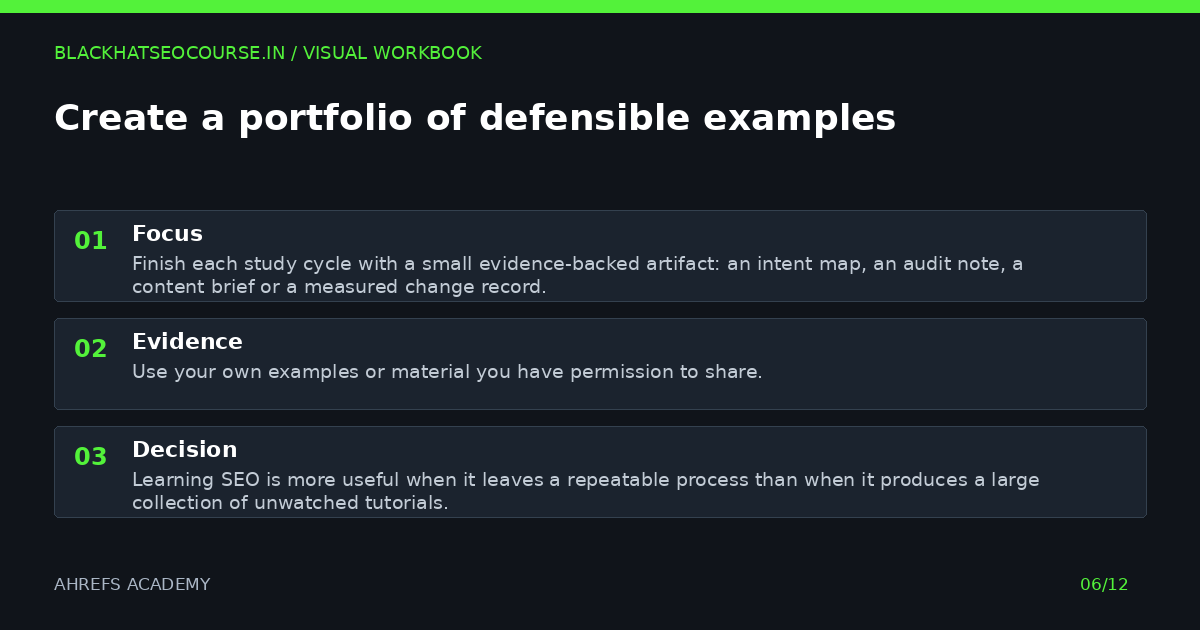
Finish each study cycle with a small evidence-backed artifact: an intent map, an audit note, a content brief or a measured change record. Include the scope, the source date, the decision and the remaining uncertainty. Use your own examples or material you have permission to share. Remove private account information before showing work to another person.
Review progress by the quality of the decisions you can explain. Revisit the official Academy catalog when you need a particular skill, because offerings and interfaces can change. Keep a sustainable practice schedule and improve one weak area at a time. Learning SEO is more useful when it leaves a repeatable process than when it produces a large collection of unwatched tutorials.
Measurement and review plan
| Record | Before | After | Purpose |
|---|---|---|---|
| Landing page | Preserve URL and state | Check intended destination | Track page ownership |
| Query cohort | Save filters and dates | Use matching conditions | Keep comparisons meaningful |
| Implementation | Document hypothesis | Verify actual change | Separate action from outcome |
| Review | Define decision criterion | Record support and uncertainty | Choose next step |
Search measurement glossary
- Impressions
- The number of times a result was shown in the selected Search Console report.
- Clicks
- The clicks recorded for results in the same Search Console report scope.
Related resources from the report
The ten leading traffic URLs are ordered by clicks, with impressions breaking ties. Their reading order rotates across the five new articles. This list includes homepage, course, forum, industry and blog pages.
Visual learning and implementation workbook
Use these six distinct worksheets to retain your own evidence, decisions and review notes.
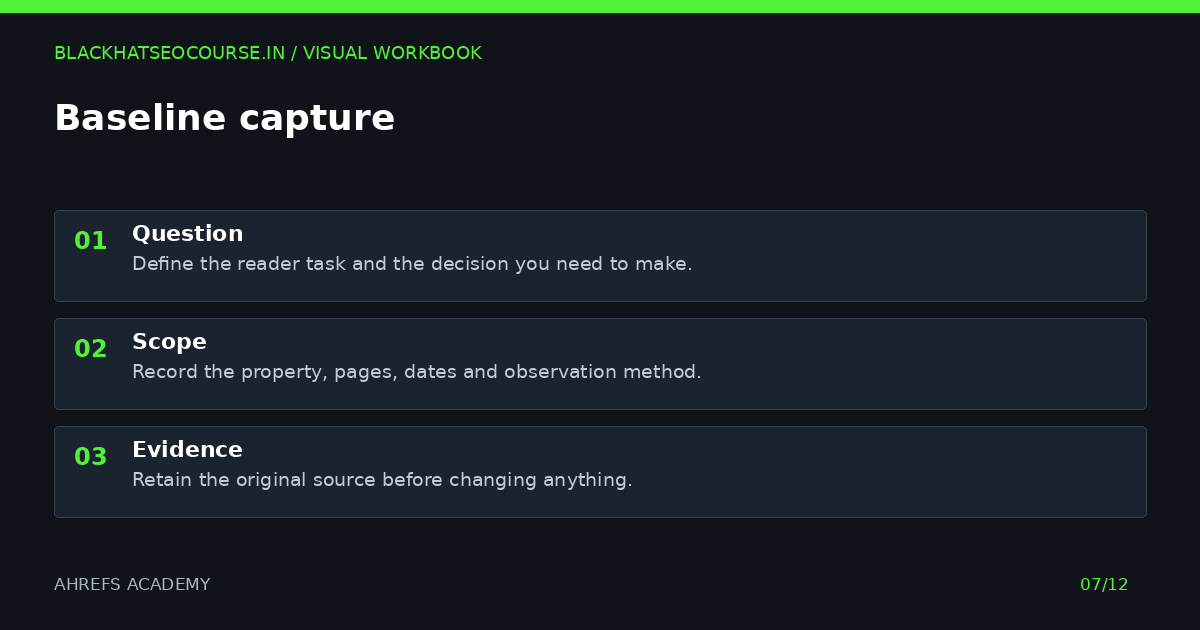
Question: Define the reader task and the decision you need to make. Scope: Record the property, pages, dates and observation method. Evidence: Retain the original source before changing anything.
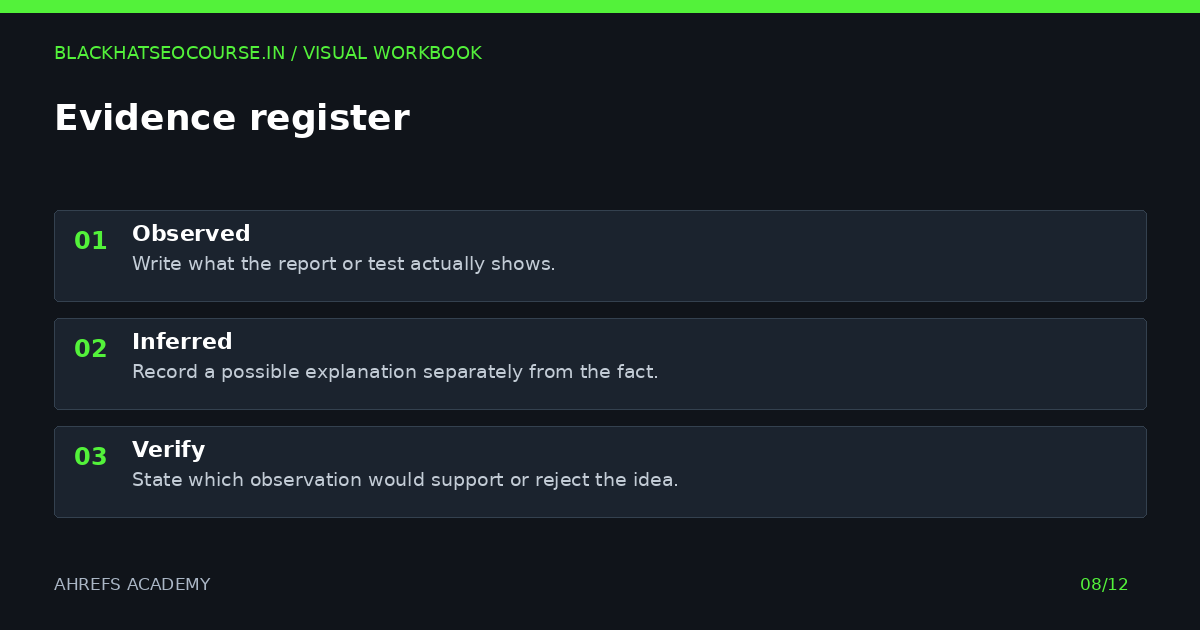
Observed: Write what the report or test actually shows. Inferred: Record a possible explanation separately from the fact. Verify: State which observation would support or reject the idea.
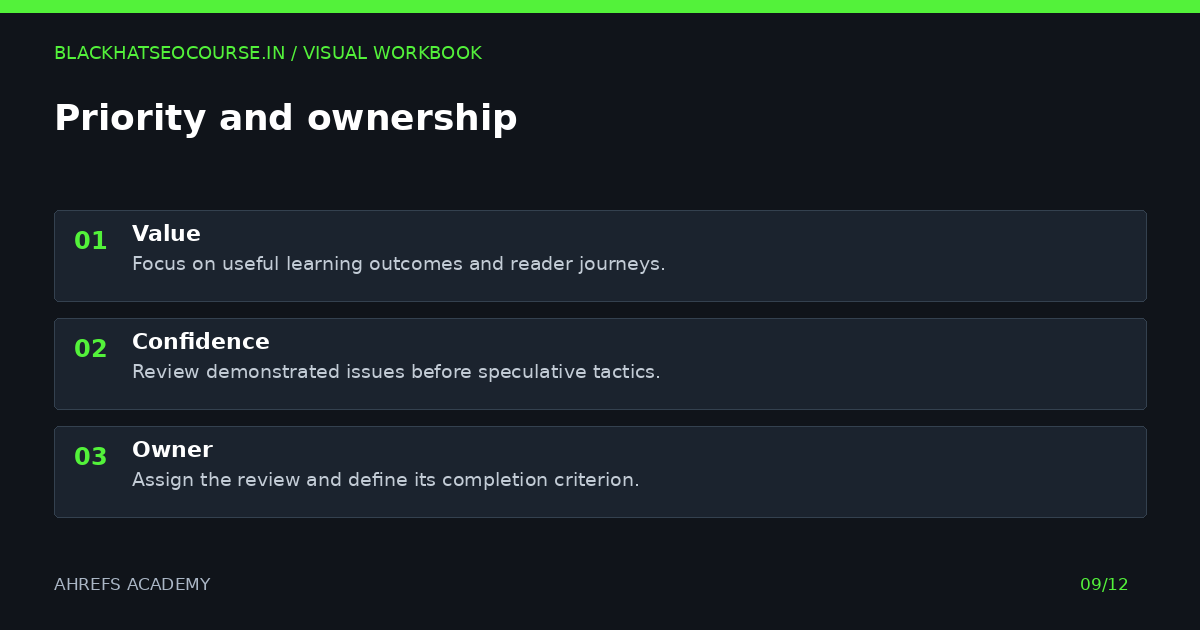
Value: Focus on useful learning outcomes and reader journeys. Confidence: Review demonstrated issues before speculative tactics. Owner: Assign the review and define its completion criterion.
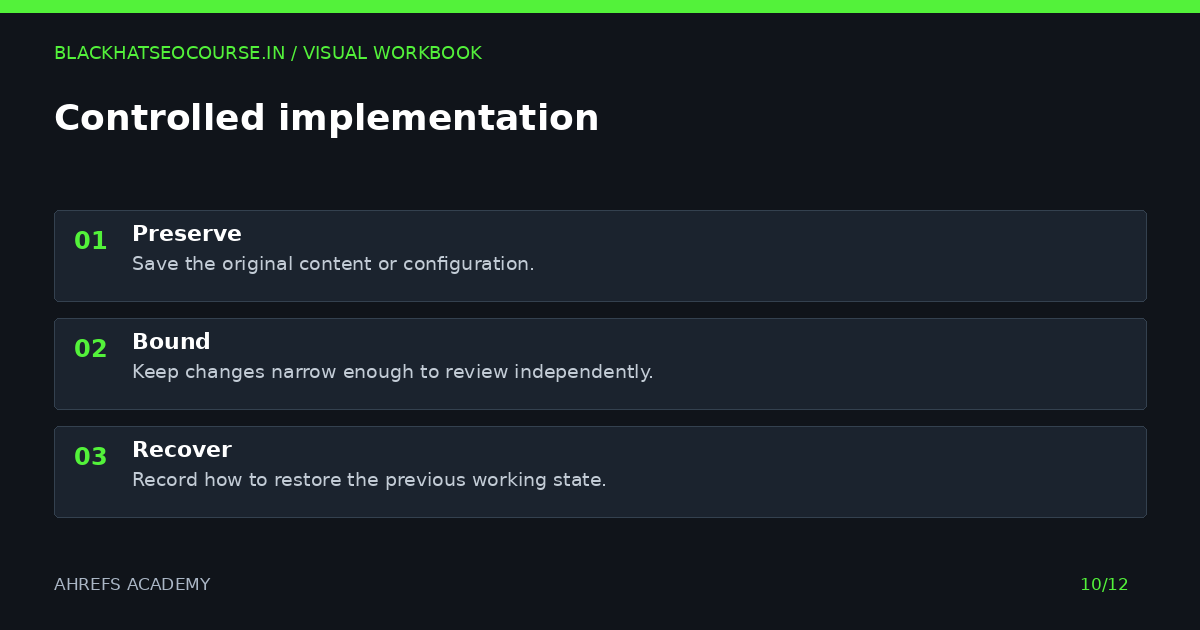
Preserve: Save the original content or configuration. Bound: Keep changes narrow enough to review independently. Recover: Record how to restore the previous working state.
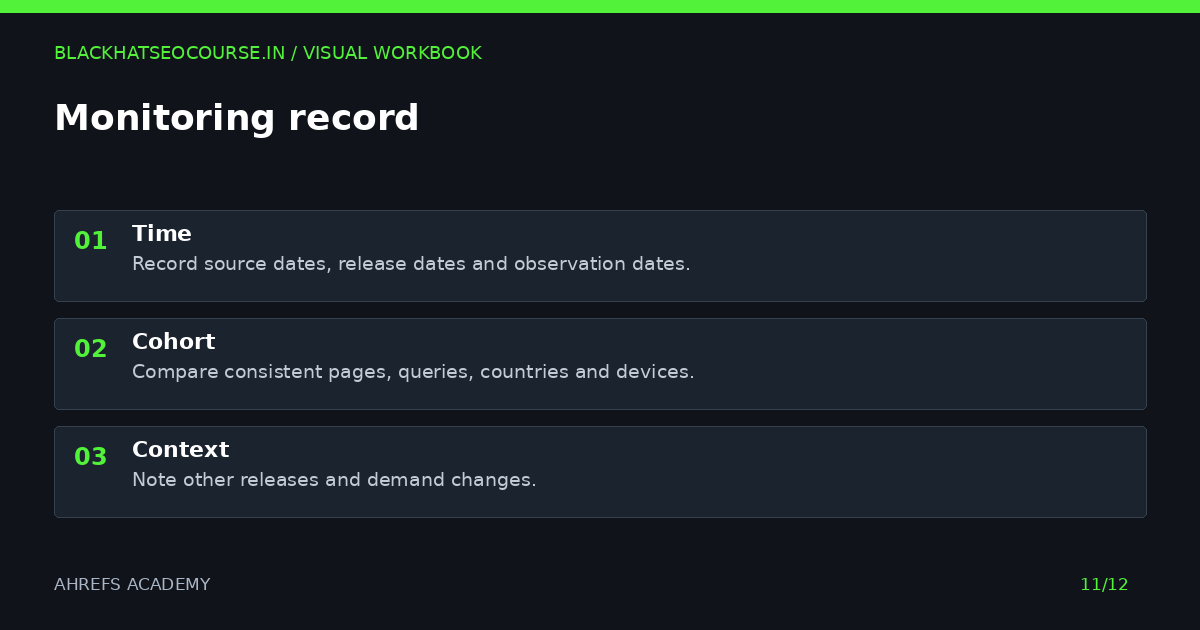
Time: Record source dates, release dates and observation dates. Cohort: Compare consistent pages, queries, countries and devices. Context: Note other releases and demand changes.
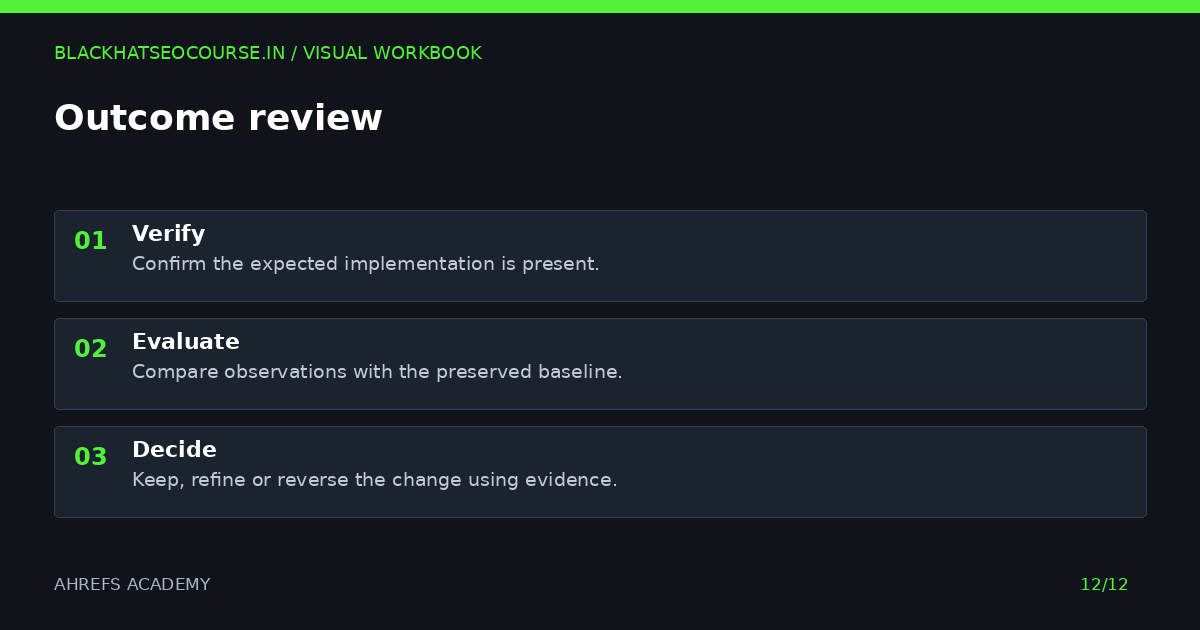
Verify: Confirm the expected implementation is present. Evaluate: Compare observations with the preserved baseline. Decide: Keep, refine or reverse the change using evidence.
Frequently asked questions
What should I check first?+
Ahrefs Academy is Ahrefs' own educational resource, with video tutorials and learning material about its tools and digital marketing.
Does the report identify the ranking URL for every query?+
No. Separate Queries and Pages exports do not establish an exact query-to-page relationship. Use appropriately filtered reports to verify it.
Should existing pages be replaced?+
Preserve useful pages unless a technical or content review supports a specific consolidation or replacement.
How should I evaluate a claim?+
Check the source, dates, measurement scope, test conditions and evidence. Separate a reported observation from an explanation of its cause.
Is a ranking improvement guaranteed?+
No. Use useful content, accountable implementation and consistent measurement to guide the next decision.
Image credit and reuse
These twelve original instructional graphics were prepared for BlackHatSEOCourse.in. Credit: BlackHatSEOCourse.in — original guide artwork. For permission to reproduce or adapt a graphic, identify the image and contact the site through the WhatsApp link on this page. No third-party stock photography is included.
Request image reuse permissionDownload the companion PDF
Use the printable guide, checklists and implementation workbook alongside the live article.
Official sources and further checks
Choose your next action
Record one specific question, gather the supporting evidence and assign a practical review. Keep the original state and judge progress using comparable observations. Use the related resources to investigate a task in more depth rather than treating page volume as the objective.
BlackHatSEOCourse.in
Explore training, tools, forums and learning resources.
BlackHatSEOCourse.in — Home