Black Hat SEO Services: Review Scope, Evidence and Ownership
Assess SEO service proposals using transparent deliverables, accountable access, search-policy review and a documented measurement plan.
Define what the provider will actually do
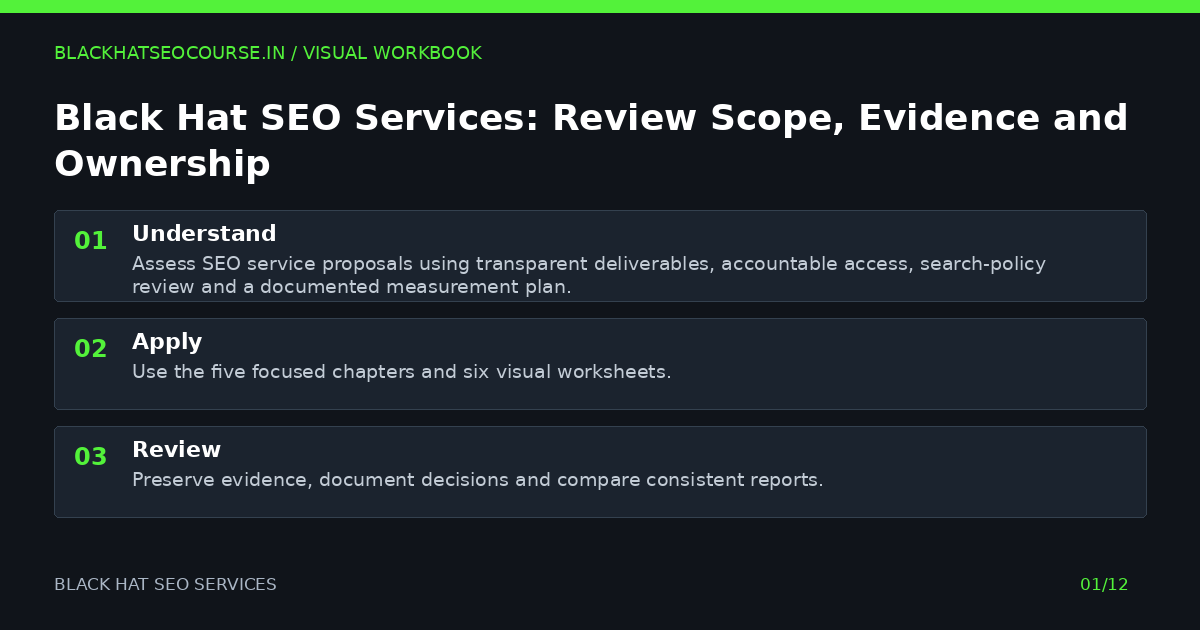
Black hat SEO services is a broad search phrase commonly associated with efforts to manipulate search rankings. Before evaluating an offer, translate the label into concrete tasks. Ask which URLs, accounts and external properties will be affected, what will be published and how the output can be reviewed. A proposal that lists activity counts without explaining the implementation does not provide enough information for an informed decision.
- Define the reader task before choosing a tactic.
- Keep observations separate from assumptions.
- Preserve relevant existing resources.
- Record changes and review their outcomes.
Table of contents
- Define what the provider will actually do
- Query Performance Snapshot
- Define what the provider will actually do
- Inspect policy exposure and external dependencies
- Keep business assets under business control
- Use a review scorecard for deliverables
- Start with a controlled improvement cycle
- Measurement and review plan
- Related resources from the report
- Visual learning and implementation workbook
- Frequently asked questions
- Image credit and reuse
- Download the companion PDF
- Official sources and further checks
- Choose your next action
- BlackHatSEOCourse.in
- Five new learning guides
Query Performance Snapshot
| Query | Clicks | Impressions | CTR | Avg Position |
|---|---|---|---|---|
| black hat seo services | 2 | 77 | 2.60% | 37.31 |
These historical measurements come from the supplied Queries sheet. They describe this property and report scope, not total market demand or a current live ranking. The Queries and Pages tabs are not joined query-to-page data.
Define what the provider will actually do
Black hat SEO services is a broad search phrase commonly associated with efforts to manipulate search rankings. Before evaluating an offer, translate the label into concrete tasks. Ask which URLs, accounts and external properties will be affected, what will be published and how the output can be reviewed. A proposal that lists activity counts without explaining the implementation does not provide enough information for an informed decision.
Keep educational discussion separate from an authorization to deploy a tactic. The review should explain how the proposed work helps readers and what exposure it creates for the business. Require the provider to distinguish technical maintenance, editorial work, link placement and automated publishing. Each category needs its own evidence and completion criteria.
Inspect policy exposure and external dependencies
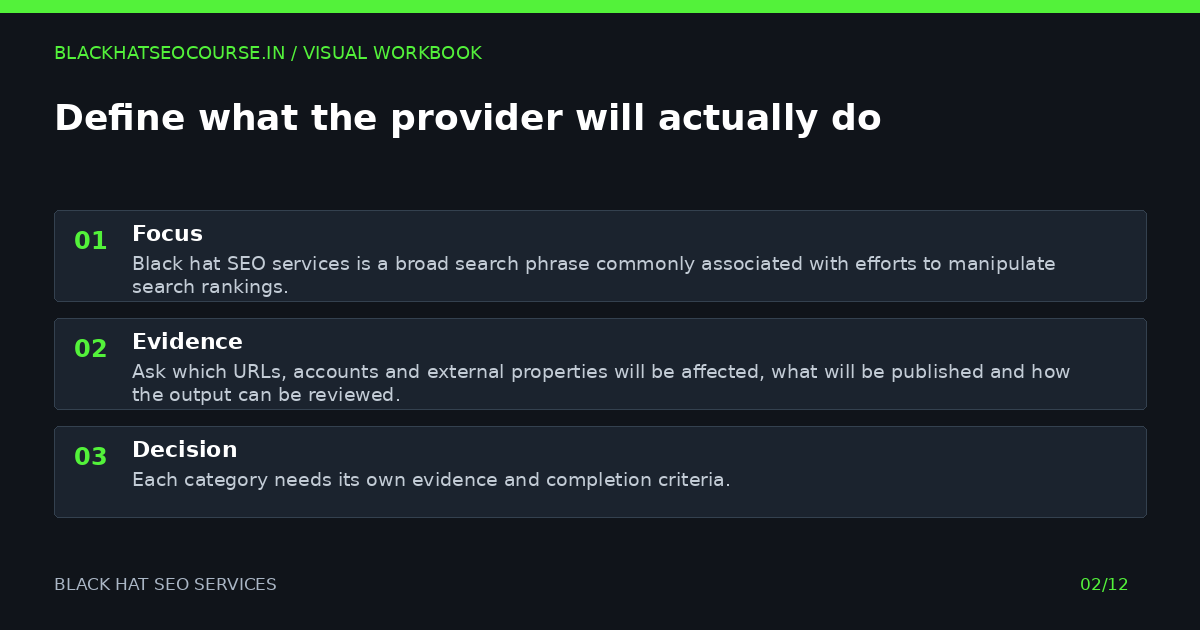
Review current Google spam policies before accepting assurances that a tactic is safe. Ask whether links or pages depend on networks, rented placements or accounts controlled only by the vendor. Those dependencies affect ownership and maintenance even if a short-term visibility change appears favorable. Require a readable inventory of where work is performed and which assets the business can retain after the engagement ends.
Avoid fabricated reviews, hidden keyword blocks and schema that describes nonexistent products or ratings. Passing a syntax test does not establish that a claim is true. A provider should be able to explain why a page or placement exists for users. Keep unresolved questions in the proposal review rather than treating secrecy as evidence of expertise.
Continue with Gambling as a complementary reference. Sector and technique pages have their own scope; a report entry is not evidence that a tactic works or that one industry example applies to another.

Keep business assets under business control
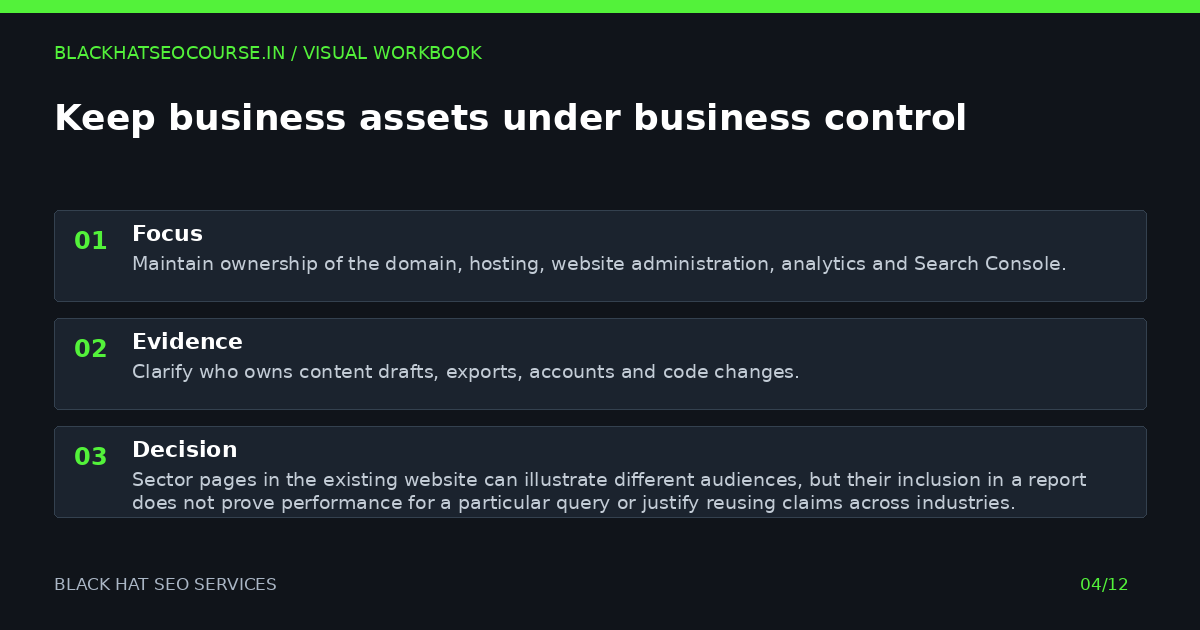
Maintain ownership of the domain, hosting, website administration, analytics and Search Console. Give collaborators access that matches the agreed task and retain a way to remove it. Clarify who owns content drafts, exports, accounts and code changes. A usable handover should allow another team to understand and maintain the work without relying on an undocumented vendor system.
Preserve a baseline before changes reach important pages. Record the release, the owner and the verification step. For technical changes, document the previous configuration and a rollback path. Sector pages in the existing website can illustrate different audiences, but their inclusion in a report does not prove performance for a particular query or justify reusing claims across industries.
Use a review scorecard for deliverables
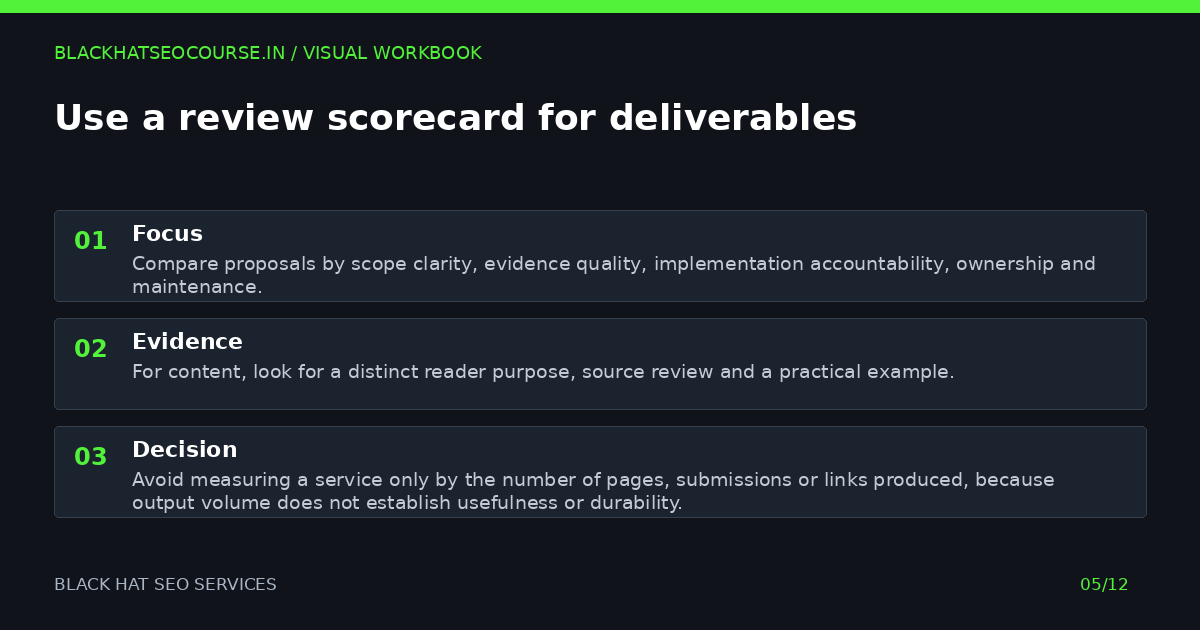
Compare proposals by scope clarity, evidence quality, implementation accountability, ownership and maintenance. Ask for a sample audit finding that becomes a specific task with a responsible owner. For content, look for a distinct reader purpose, source review and a practical example. For technical work, look for reproducible evidence rather than a long list of tool warnings that no one has checked.
Set acceptance criteria before the work begins. A verified canonical repair on a defined URL set is an implementation outcome; a future ranking is a separate observation. Keep both visible in reporting. Avoid measuring a service only by the number of pages, submissions or links produced, because output volume does not establish usefulness or durability.
Continue with Airlines as a complementary reference. Sector and technique pages have their own scope; a report entry is not evidence that a tactic works or that one industry example applies to another.
Start with a controlled improvement cycle
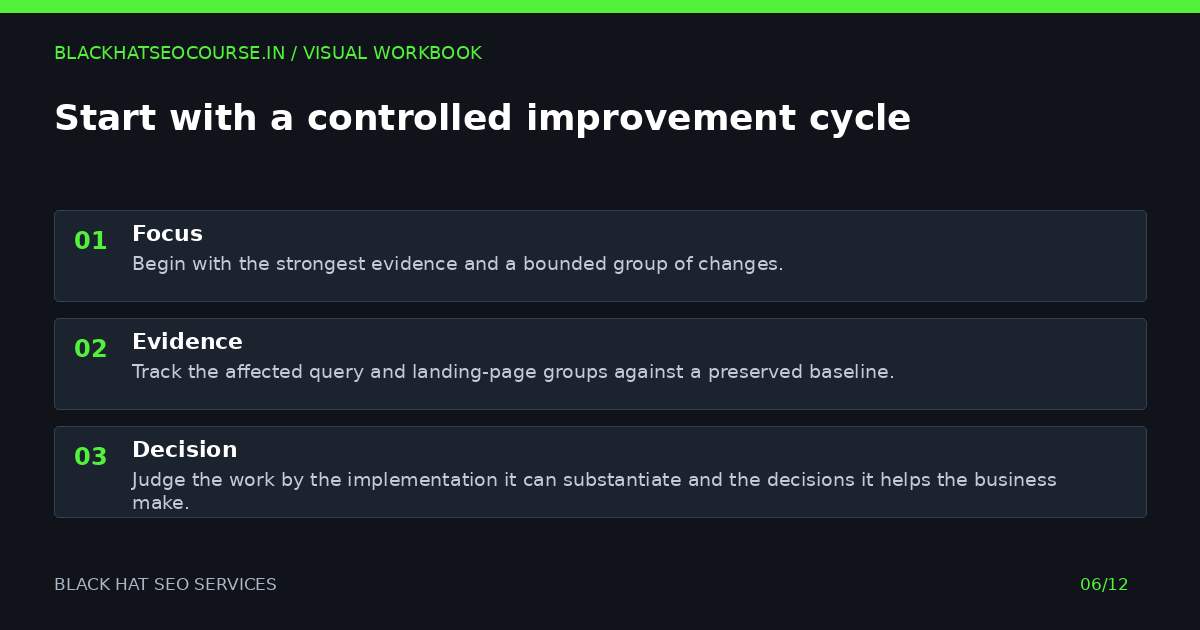
Begin with the strongest evidence and a bounded group of changes. Correct demonstrated accessibility or indexing faults, improve useful existing pages and clarify relevant internal links. Track the affected query and landing-page groups against a preserved baseline. Keep unrelated changes separate where possible so that the review can explain what happened after each release.
Reassess the original hypothesis when the evidence is weak. A useful engagement leaves clearer content, maintainable configuration and an understandable reporting method. No provider can guarantee a particular organic position. Judge the work by the implementation it can substantiate and the decisions it helps the business make.
Measurement and review plan
| Record | Before | After | Purpose |
|---|---|---|---|
| Landing page | Preserve URL and state | Check intended destination | Track page ownership |
| Query cohort | Save filters and dates | Use matching conditions | Keep comparisons meaningful |
| Implementation | Document hypothesis | Verify actual change | Separate action from outcome |
| Review | Define decision criterion | Record support and uncertainty | Choose next step |
Search measurement glossary
- Impressions
- The number of times a result was shown in the selected Search Console report.
- Clicks
- The clicks recorded for results in the same Search Console report scope.
Related resources from the report
The ten leading traffic URLs are ordered by clicks, with impressions breaking ties. Their reading order rotates across the five new articles. This list includes homepage, course, forum, industry and blog pages.
Visual learning and implementation workbook
Use these six distinct worksheets to retain your own evidence, decisions and review notes.
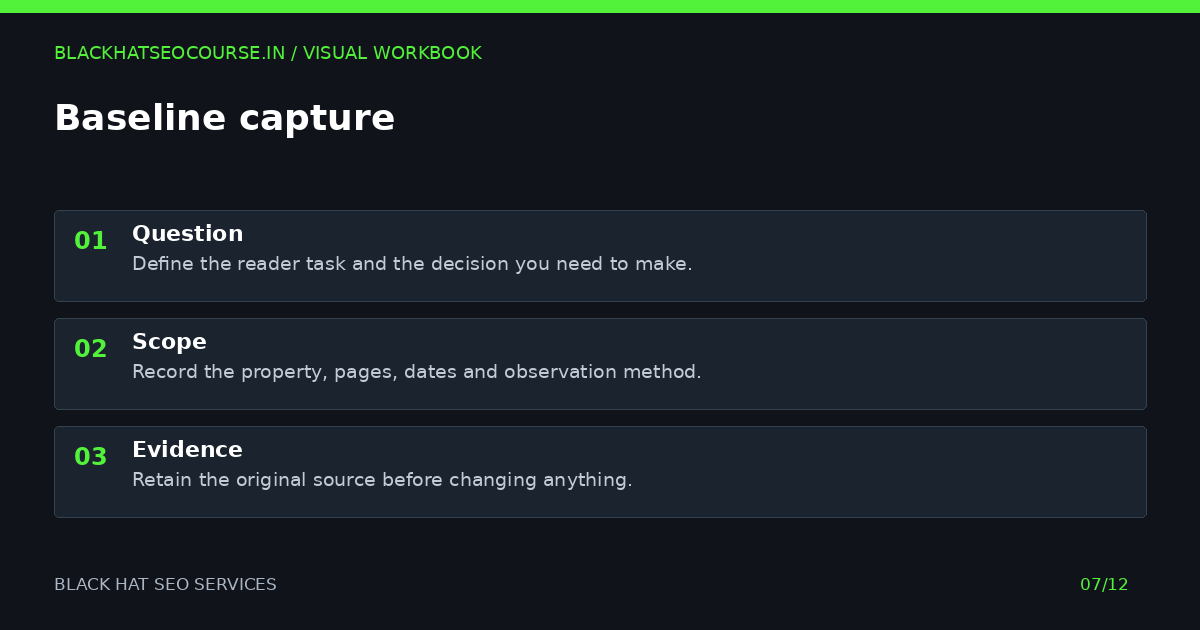
Question: Define the reader task and the decision you need to make. Scope: Record the property, pages, dates and observation method. Evidence: Retain the original source before changing anything.
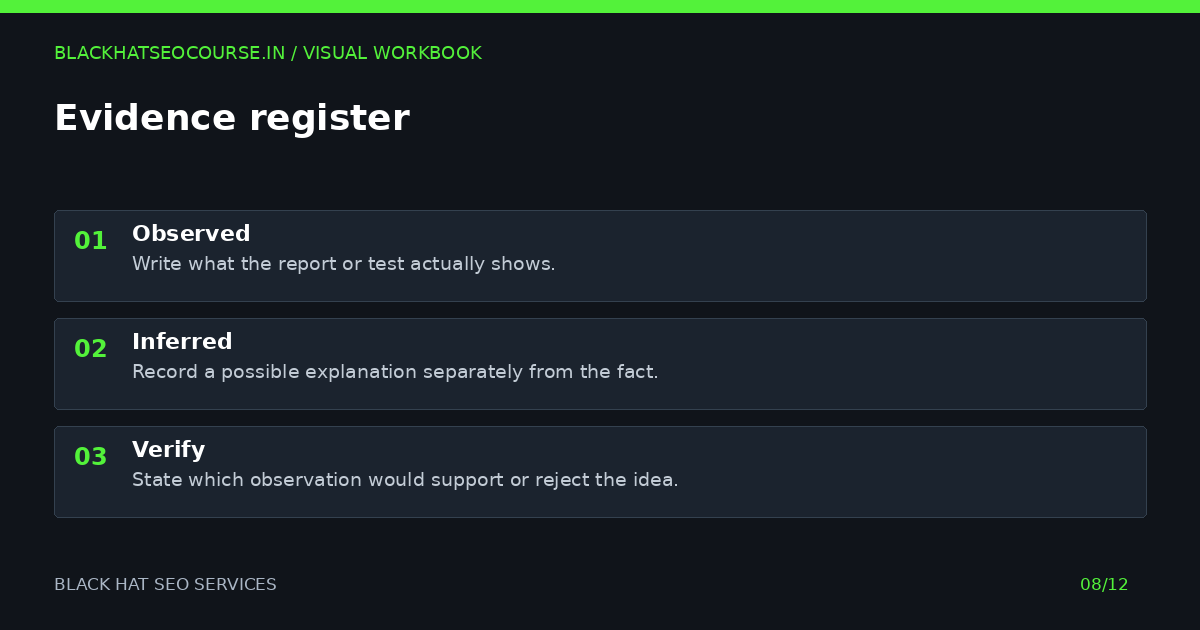
Observed: Write what the report or test actually shows. Inferred: Record a possible explanation separately from the fact. Verify: State which observation would support or reject the idea.
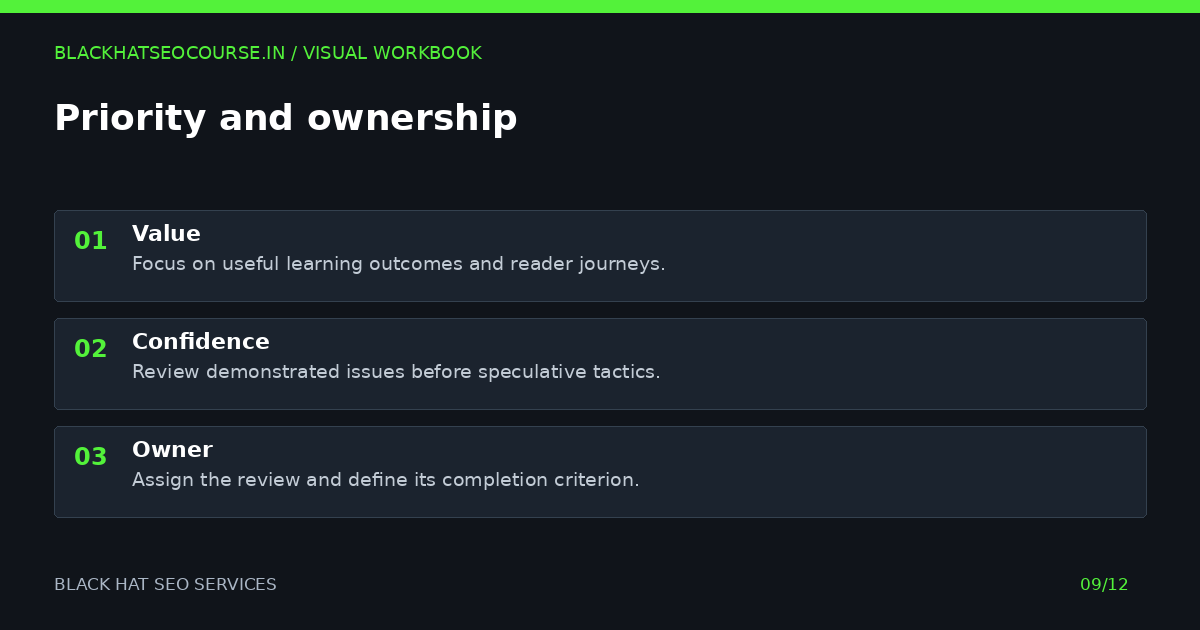
Value: Focus on useful learning outcomes and reader journeys. Confidence: Review demonstrated issues before speculative tactics. Owner: Assign the review and define its completion criterion.
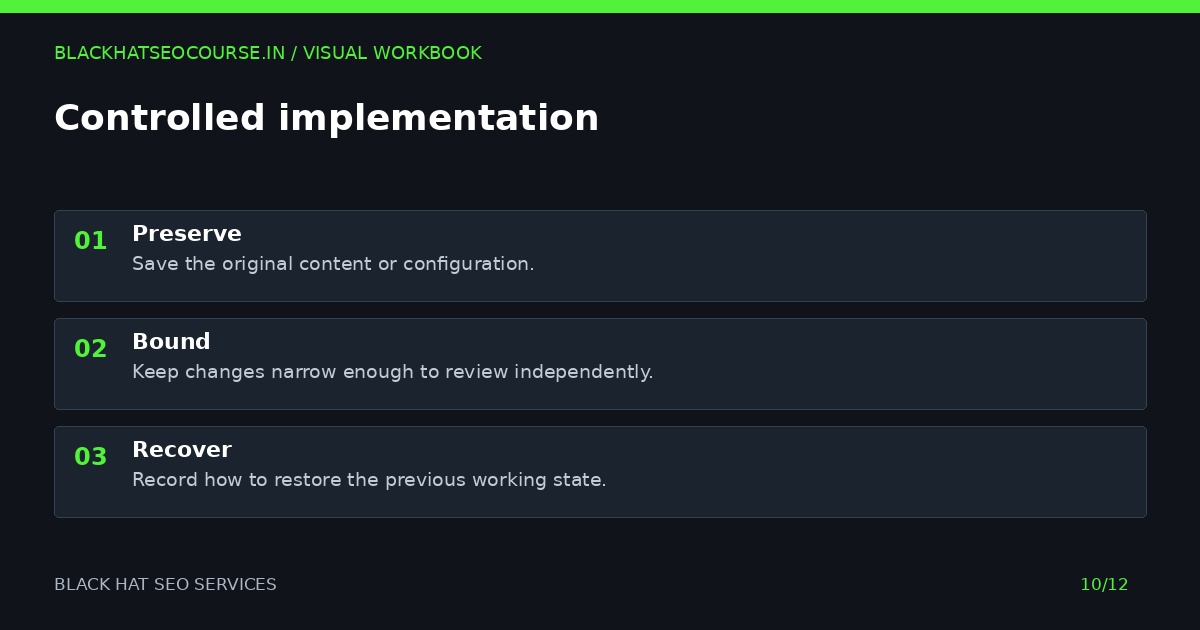
Preserve: Save the original content or configuration. Bound: Keep changes narrow enough to review independently. Recover: Record how to restore the previous working state.
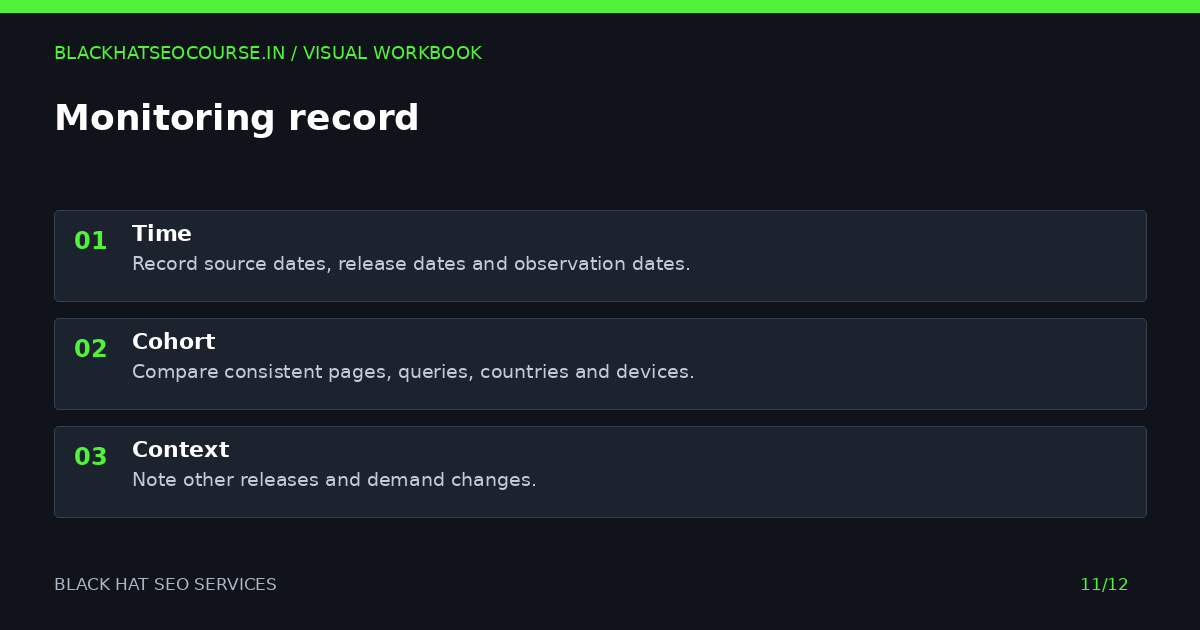
Time: Record source dates, release dates and observation dates. Cohort: Compare consistent pages, queries, countries and devices. Context: Note other releases and demand changes.

Verify: Confirm the expected implementation is present. Evaluate: Compare observations with the preserved baseline. Decide: Keep, refine or reverse the change using evidence.
Frequently asked questions
What should I check first?+
Black hat SEO services is a broad search phrase commonly associated with efforts to manipulate search rankings.
Does the report identify the ranking URL for every query?+
No. Separate Queries and Pages exports do not establish an exact query-to-page relationship. Use appropriately filtered reports to verify it.
Should existing pages be replaced?+
Preserve useful pages unless a technical or content review supports a specific consolidation or replacement.
How should I evaluate a claim?+
Check the source, dates, measurement scope, test conditions and evidence. Separate a reported observation from an explanation of its cause.
Is a ranking improvement guaranteed?+
No. Use useful content, accountable implementation and consistent measurement to guide the next decision.
Image credit and reuse
These twelve original instructional graphics were prepared for BlackHatSEOCourse.in. Credit: BlackHatSEOCourse.in — original guide artwork. For permission to reproduce or adapt a graphic, identify the image and contact the site through the WhatsApp link on this page. No third-party stock photography is included.
Request image reuse permissionDownload the companion PDF
Use the printable guide, checklists and implementation workbook alongside the live article.
Official sources and further checks
Choose your next action
Record one specific question, gather the supporting evidence and assign a practical review. Keep the original state and judge progress using comparable observations. Use the related resources to investigate a task in more depth rather than treating page volume as the objective.
BlackHatSEOCourse.in
Explore training, tools, forums and learning resources.
BlackHatSEOCourse.in — Home