Black Hat SEO Forum: Evaluate Advice Before Applying It
Use SEO forums as research inputs while checking dates, incentives, test conditions and account-access risks before acting on a claim.
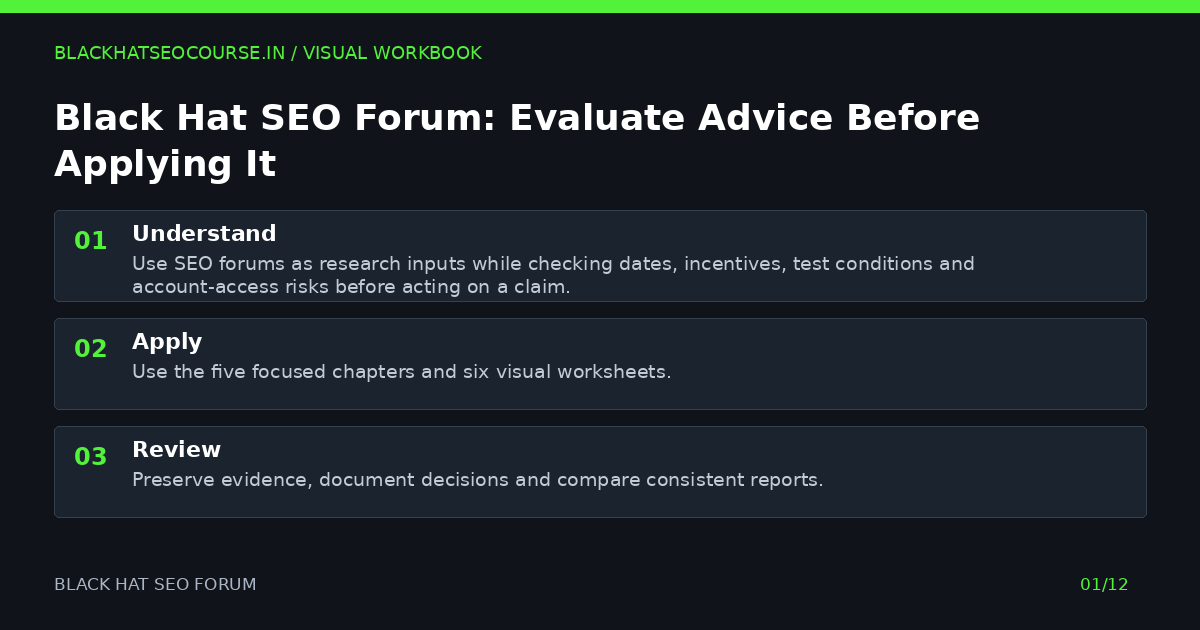
Read a forum claim as a starting hypothesis
A black hat SEO forum can contain discussions about tools, services, traffic and ranking experiments. The quality of those discussions varies. Treat a claim as something to investigate rather than a proven method simply because it is popular or repeated. Record the date, the type of website involved and the outcome being claimed. An old thread may describe a product interface or search environment that no longer applies.
- Define the reader task before choosing a tactic.
- Keep observations separate from assumptions.
- Preserve relevant existing resources.
- Record changes and review their outcomes.
Table of contents
- Read a forum claim as a starting hypothesis
- Query Performance Snapshot
- Read a forum claim as a starting hypothesis
- Check the evidence behind screenshots
- Identify incentives and access requests
- Design a bounded review instead of copying a tactic
- Keep a verified learning notebook
- Measurement and review plan
- Related resources from the report
- Visual learning and implementation workbook
- Frequently asked questions
- Image credit and reuse
- Download the companion PDF
- Official sources and further checks
- Choose your next action
- BlackHatSEOCourse.in
- Five new learning guides
Query Performance Snapshot
| Query | Clicks | Impressions | CTR | Avg Position |
|---|---|---|---|---|
| black hat seo forum | 1 | 59 | 1.69% | 27.93 |
These historical measurements come from the supplied Queries sheet. They describe this property and report scope, not total market demand or a current live ranking. The Queries and Pages tabs are not joined query-to-page data.
Read a forum claim as a starting hypothesis
A black hat SEO forum can contain discussions about tools, services, traffic and ranking experiments. The quality of those discussions varies. Treat a claim as something to investigate rather than a proven method simply because it is popular or repeated. Record the date, the type of website involved and the outcome being claimed. An old thread may describe a product interface or search environment that no longer applies.
Separate a person's reported observation from the explanation attached to it. A ranking increased after a change, but that alone does not show the change caused the increase. Ask which other releases, demand changes or external events occurred during the same period. Preserve useful questions without copying unsupported conclusions into your own implementation plan.
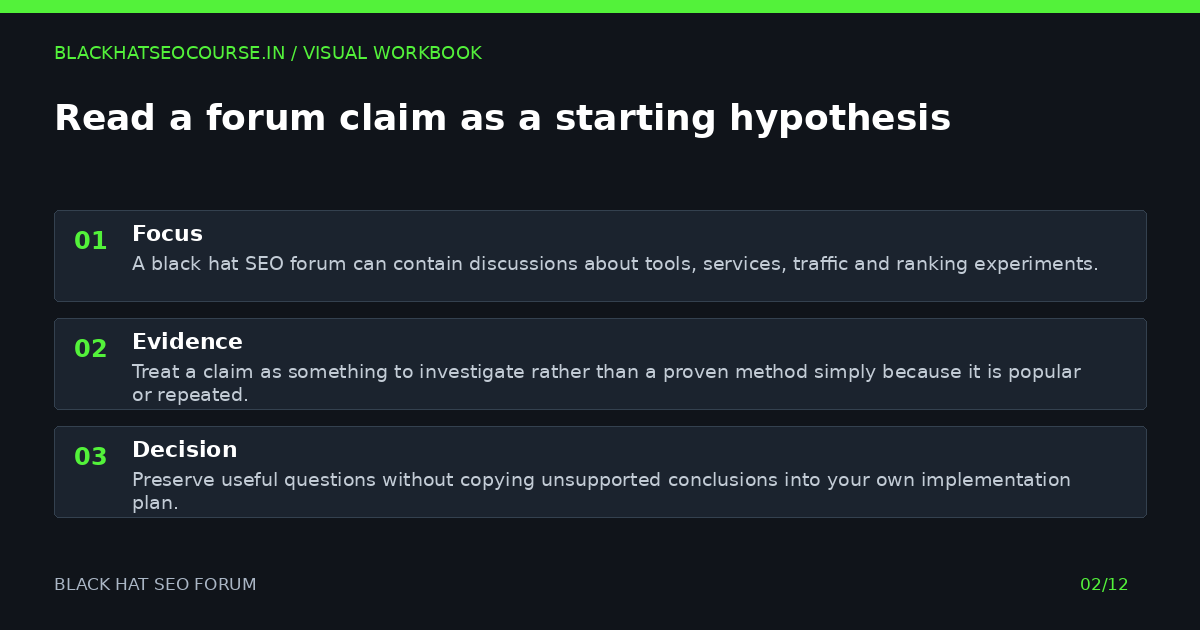
Check the evidence behind screenshots
A screenshot may show only one keyword, one location or one favorable time window. Look for consistent before-and-after conditions, the exact landing page, the observation method and the reporting range. Distinguish a rank-tracker sample from Search Console property data and from qualified business enquiries. These measurements answer different questions and should not be combined into a single success claim.
Check whether the thread includes unsuccessful examples or only selected wins. A repeatable workflow should identify the baseline, the change and the evidence used to evaluate the result. If those details are missing, label the idea as unverified. You can still learn from the question without accepting the conclusion.
Continue with Black hat forum as a complementary reference. Sector and technique pages have their own scope; a report entry is not evidence that a tactic works or that one industry example applies to another.
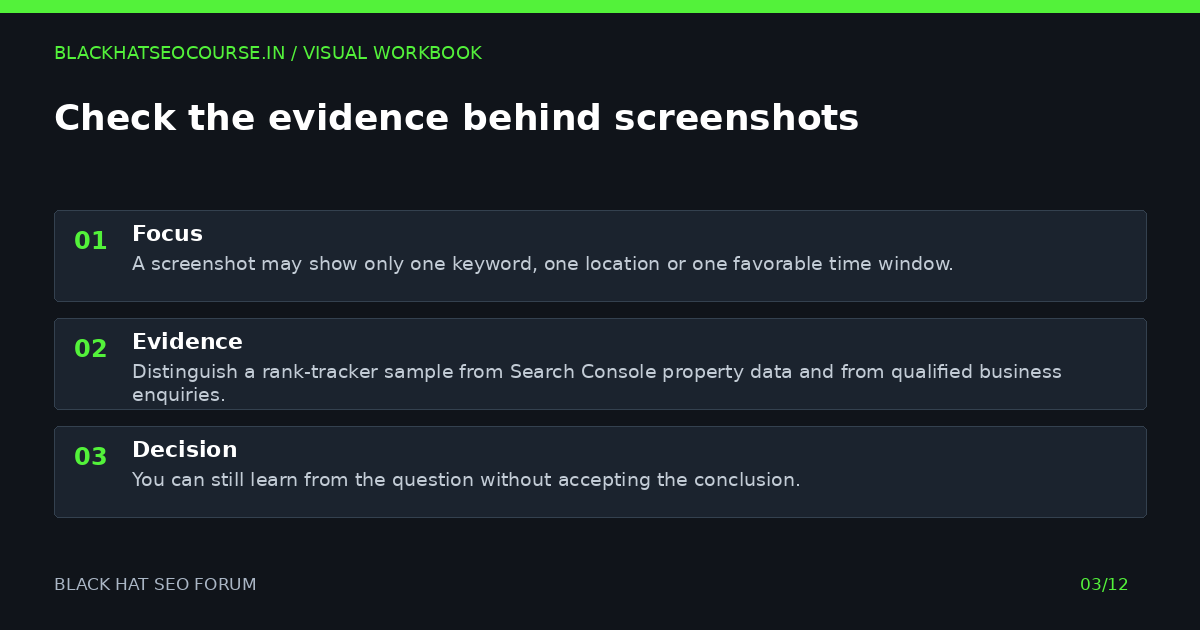
Identify incentives and access requests
Forum recommendations may come from someone selling a tool, a service or a placement. An incentive does not automatically make advice wrong, but it changes what should be verified independently. Review whether the author explains dependencies, maintenance and ownership. Avoid sharing production credentials or private client reports in a public discussion to obtain informal troubleshooting help.
Inspect software and account requests before using unfamiliar products. Prefer official distribution channels and a limited test environment for authorized evaluation. Do not confuse a download's availability with proof that it is suitable for a business website. Keep a record of what access is granted and how it can be revoked.
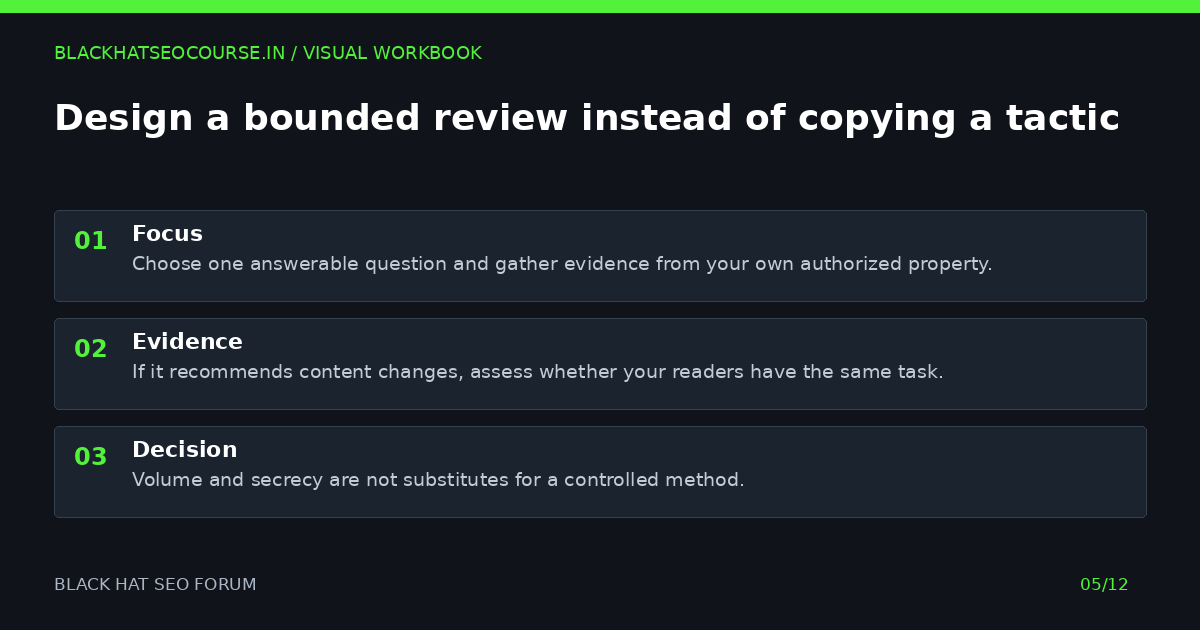
Design a bounded review instead of copying a tactic
Choose one answerable question and gather evidence from your own authorized property. If a thread discusses a technical issue, reproduce the relevant check on a small sample before changing a template. If it recommends content changes, assess whether your readers have the same task. Review current search policies when a proposal involves manipulative publishing or links.
Write the test boundary, the expected observation and the rollback condition. Keep speculative work away from broad production changes until the evidence supports it. For a useful review, another person should understand why the test was chosen and what result would change your decision. Volume and secrecy are not substitutes for a controlled method.
Continue with Best black hat forum 2026 search guide as a complementary reference. Sector and technique pages have their own scope; a report entry is not evidence that a tactic works or that one industry example applies to another.
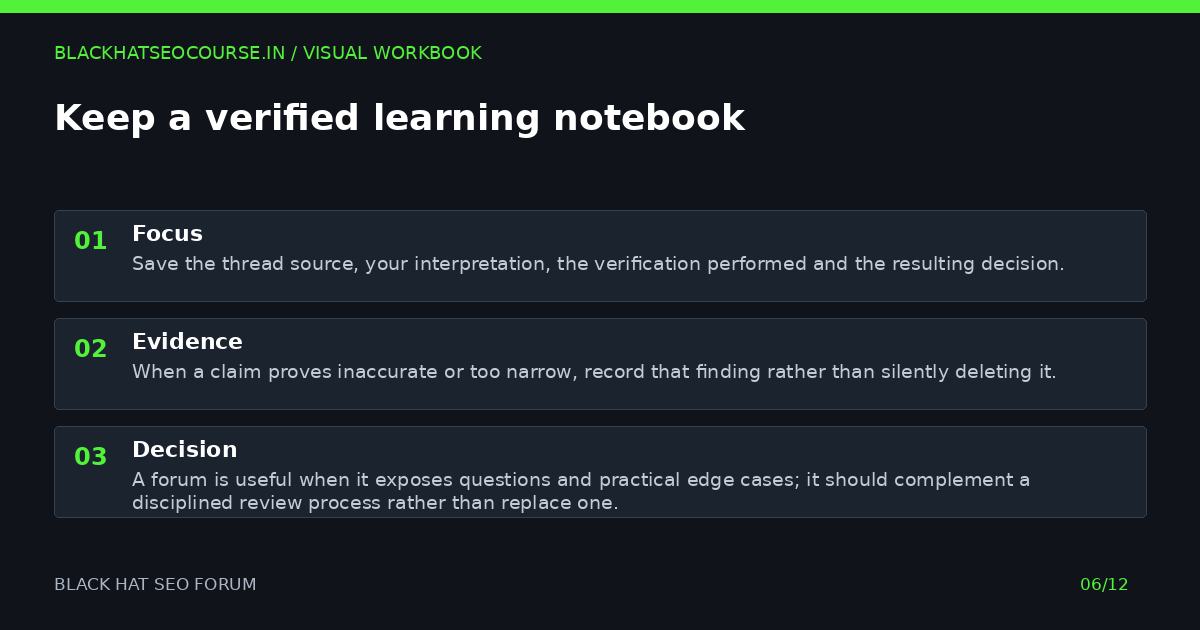
Keep a verified learning notebook
Save the thread source, your interpretation, the verification performed and the resulting decision. Keep observations and assumptions in separate columns. When a claim proves inaccurate or too narrow, record that finding rather than silently deleting it. This turns forum reading into a research process and prevents the same unsupported idea from resurfacing repeatedly.
Use official documentation and first-party measurements to resolve disagreements where possible. Share only information you are authorized to disclose. A forum is useful when it exposes questions and practical edge cases; it should complement a disciplined review process rather than replace one.
Measurement and review plan
| Record | Before | After | Purpose |
|---|---|---|---|
| Landing page | Preserve URL and state | Check intended destination | Track page ownership |
| Query cohort | Save filters and dates | Use matching conditions | Keep comparisons meaningful |
| Implementation | Document hypothesis | Verify actual change | Separate action from outcome |
| Review | Define decision criterion | Record support and uncertainty | Choose next step |
Search measurement glossary
- Impressions
- The number of times a result was shown in the selected Search Console report.
- Clicks
- The clicks recorded for results in the same Search Console report scope.
Related resources from the report
The ten leading traffic URLs are ordered by clicks, with impressions breaking ties. Their reading order rotates across the five new articles. This list includes homepage, course, forum, industry and blog pages.
Visual learning and implementation workbook
Use these six distinct worksheets to retain your own evidence, decisions and review notes.
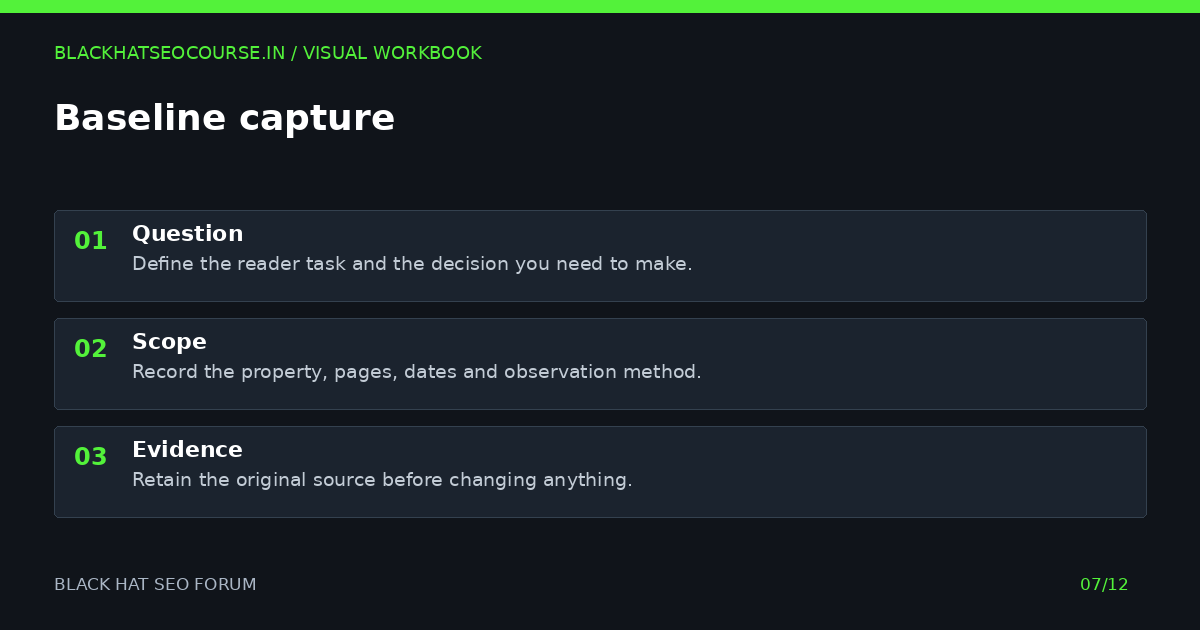
Question: Define the reader task and the decision you need to make. Scope: Record the property, pages, dates and observation method. Evidence: Retain the original source before changing anything.
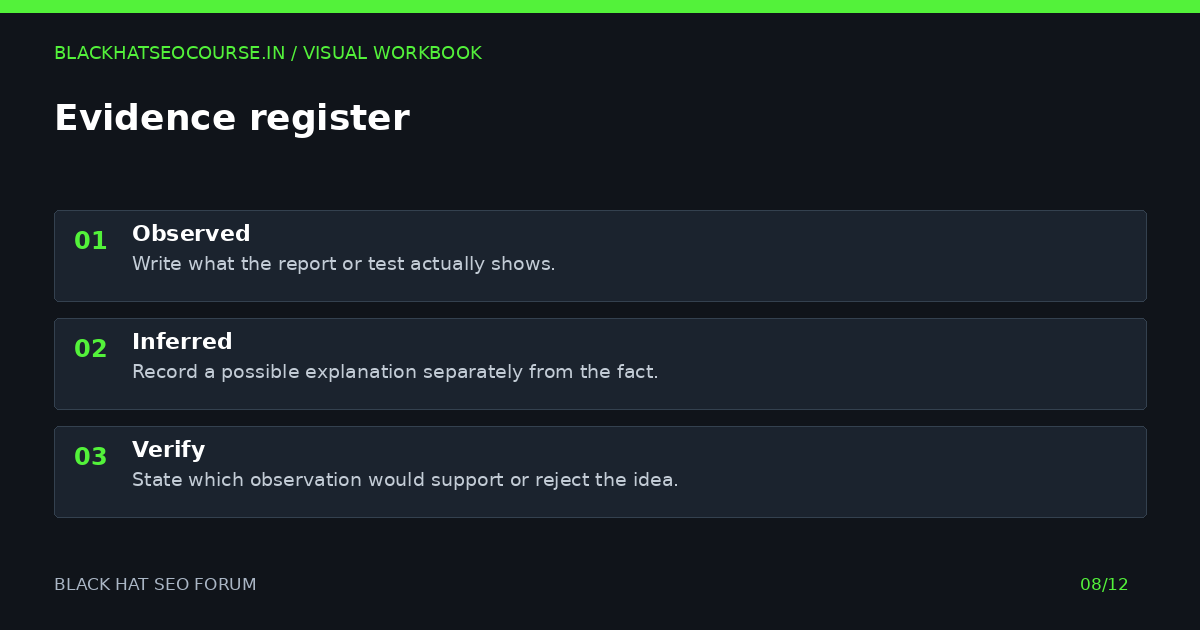
Observed: Write what the report or test actually shows. Inferred: Record a possible explanation separately from the fact. Verify: State which observation would support or reject the idea.
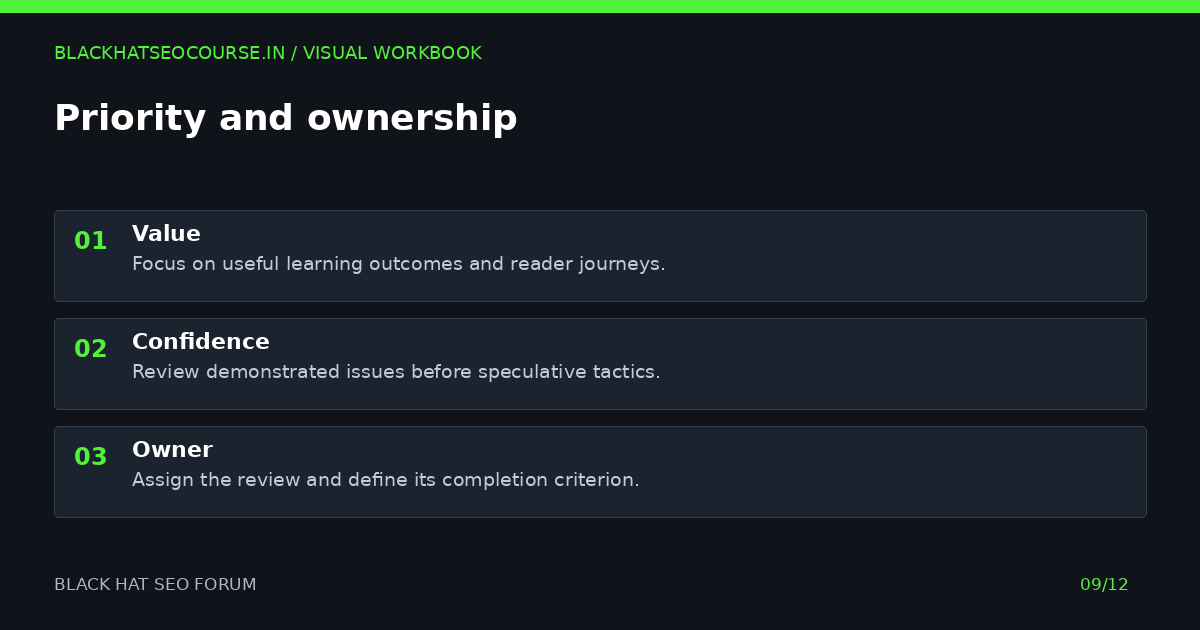
Value: Focus on useful learning outcomes and reader journeys. Confidence: Review demonstrated issues before speculative tactics. Owner: Assign the review and define its completion criterion.
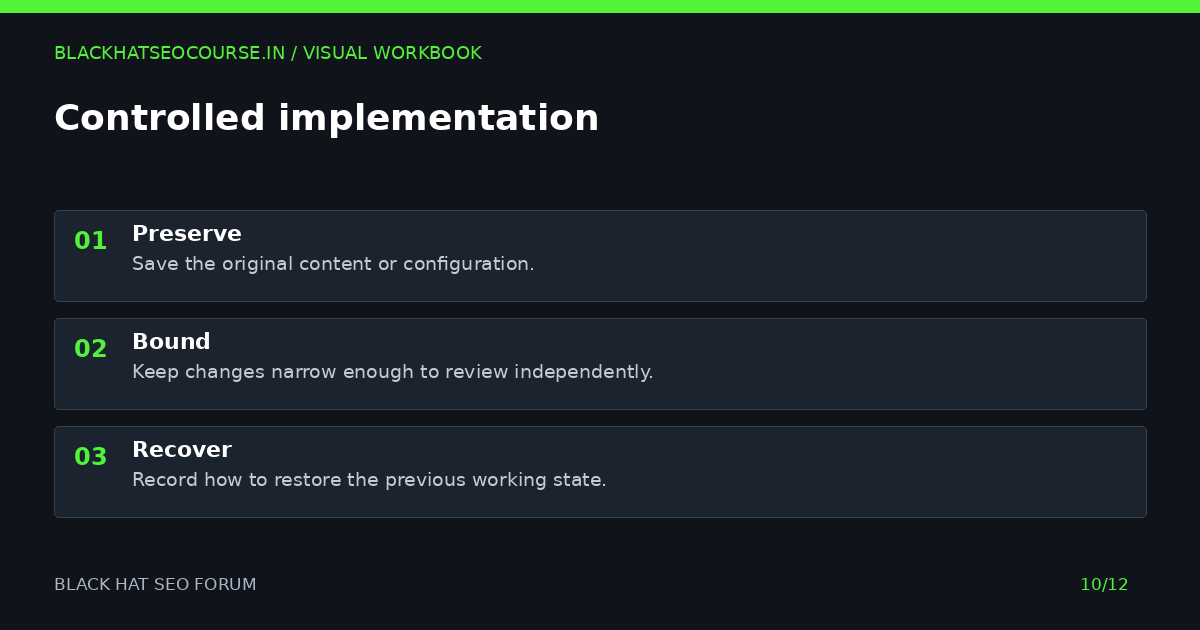
Preserve: Save the original content or configuration. Bound: Keep changes narrow enough to review independently. Recover: Record how to restore the previous working state.
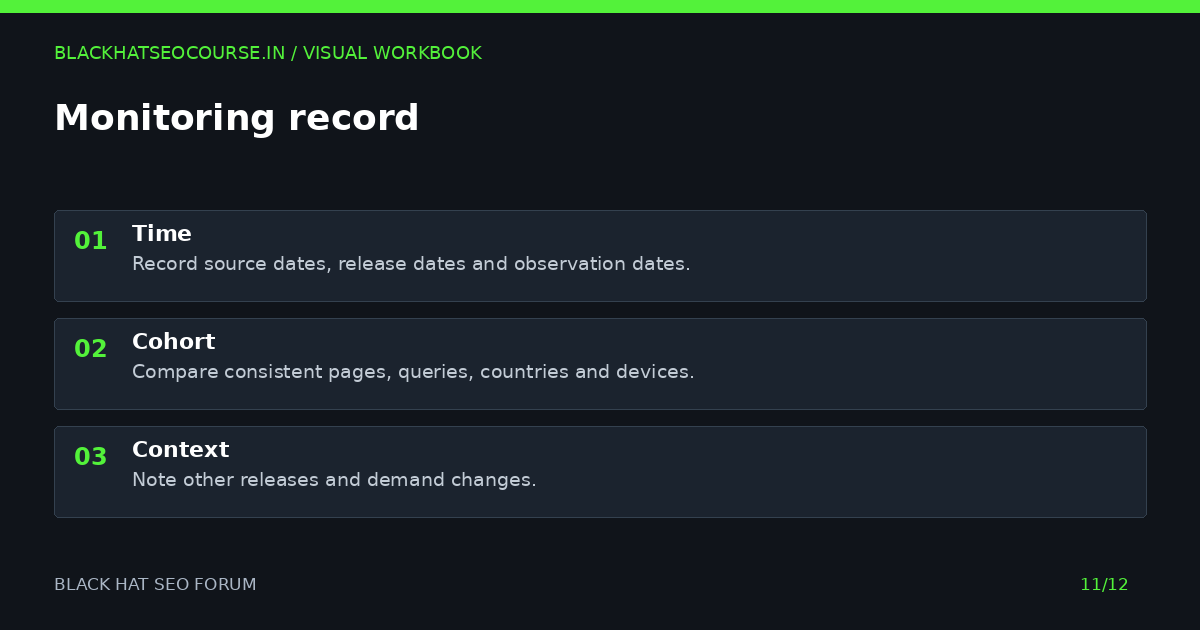
Time: Record source dates, release dates and observation dates. Cohort: Compare consistent pages, queries, countries and devices. Context: Note other releases and demand changes.
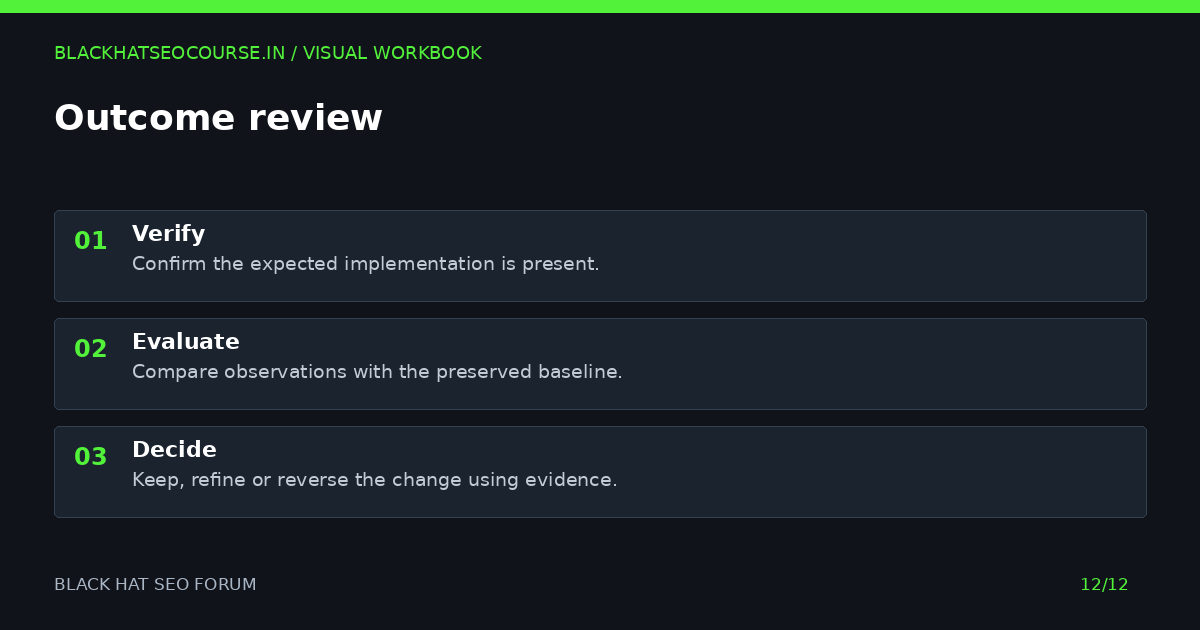
Verify: Confirm the expected implementation is present. Evaluate: Compare observations with the preserved baseline. Decide: Keep, refine or reverse the change using evidence.
Frequently asked questions
What should I check first?+
A black hat SEO forum can contain discussions about tools, services, traffic and ranking experiments.
Does the report identify the ranking URL for every query?+
No. Separate Queries and Pages exports do not establish an exact query-to-page relationship. Use appropriately filtered reports to verify it.
Should existing pages be replaced?+
Preserve useful pages unless a technical or content review supports a specific consolidation or replacement.
How should I evaluate a claim?+
Check the source, dates, measurement scope, test conditions and evidence. Separate a reported observation from an explanation of its cause.
Is a ranking improvement guaranteed?+
No. Use useful content, accountable implementation and consistent measurement to guide the next decision.
Image credit and reuse
These twelve original instructional graphics were prepared for BlackHatSEOCourse.in. Credit: BlackHatSEOCourse.in — original guide artwork. For permission to reproduce or adapt a graphic, identify the image and contact the site through the WhatsApp link on this page. No third-party stock photography is included.
Request image reuse permissionDownload the companion PDF
Use the printable guide, checklists and implementation workbook alongside the live article.
Official sources and further checks
Choose your next action
Record one specific question, gather the supporting evidence and assign a practical review. Keep the original state and judge progress using comparable observations. Use the related resources to investigate a task in more depth rather than treating page volume as the objective.
BlackHatSEOCourse.in
Explore training, tools, forums and learning resources.
BlackHatSEOCourse.in — Home